
Pantanal Jaguars 2026 Trip Report
Porto Jofre, Brazil
July 11 - 17, 2026
Wildlife Seen Today.
✔ Jaguar (Marcela)
✔ Capybaras
✔ Jacare Caiman
✔ Jabiru
✔ Water Buffalo
✔ Great Horned Owl
✔ Crab Eating Foxes
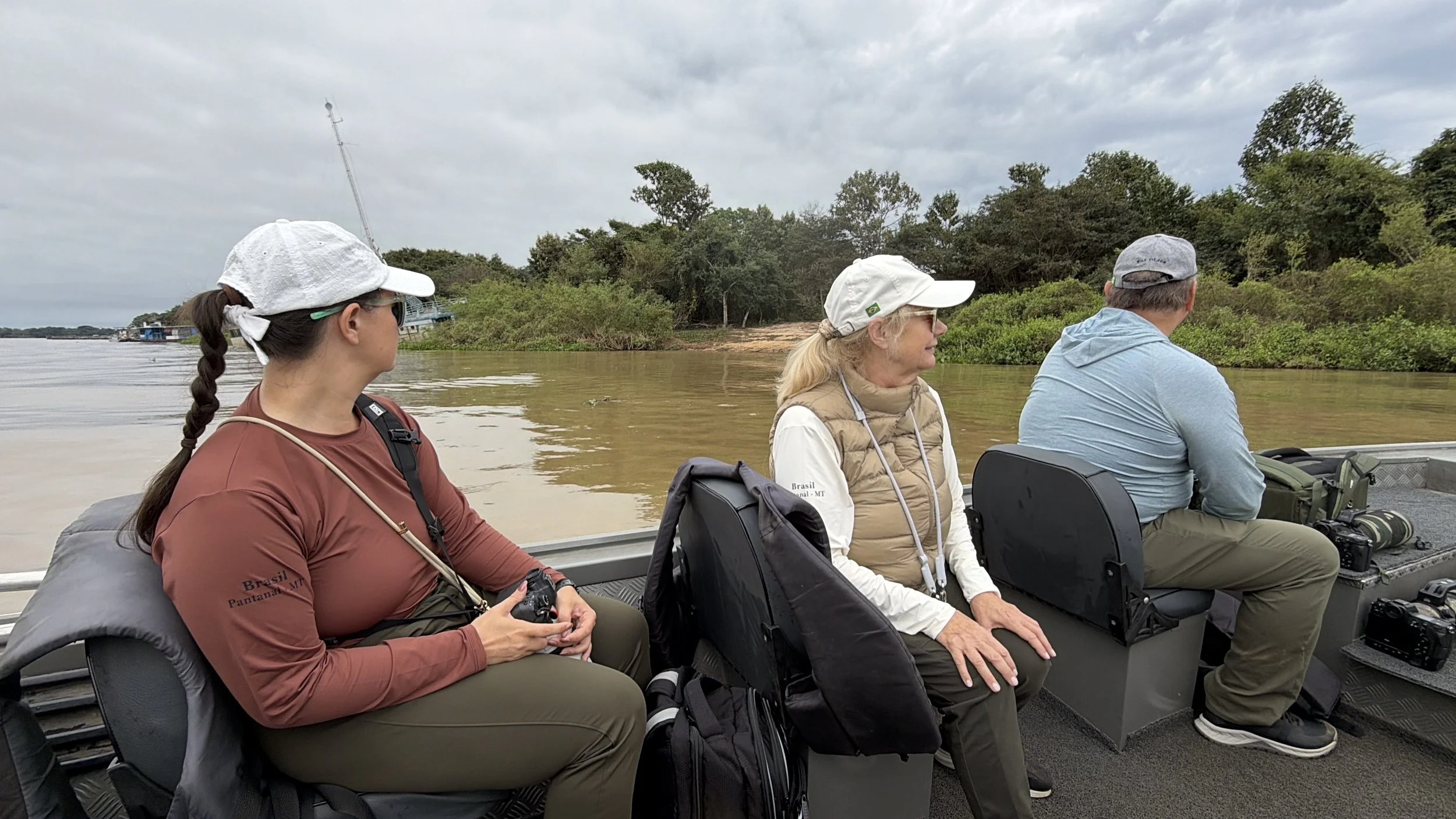
July 12, 2026. Day One
Our Pantanal adventure begins.
Four days ago I was in the Amazon searching for pink river dolphins and sloths. Today we're in the Pantanal, looking for jaguars, maned wolves, tapirs, ocelots... and whatever else this incredibly rich ecosystem decides to share with us.
We've got a great group this week. Everyone is excited about seeing it all… mammals, reptiles, and birds.
I always love when people appreciate the birds. It makes the whole experience here so much richer.
Let's see what today has in store.
Our first animal of the trip?
An anhinga enjoying breakfast.
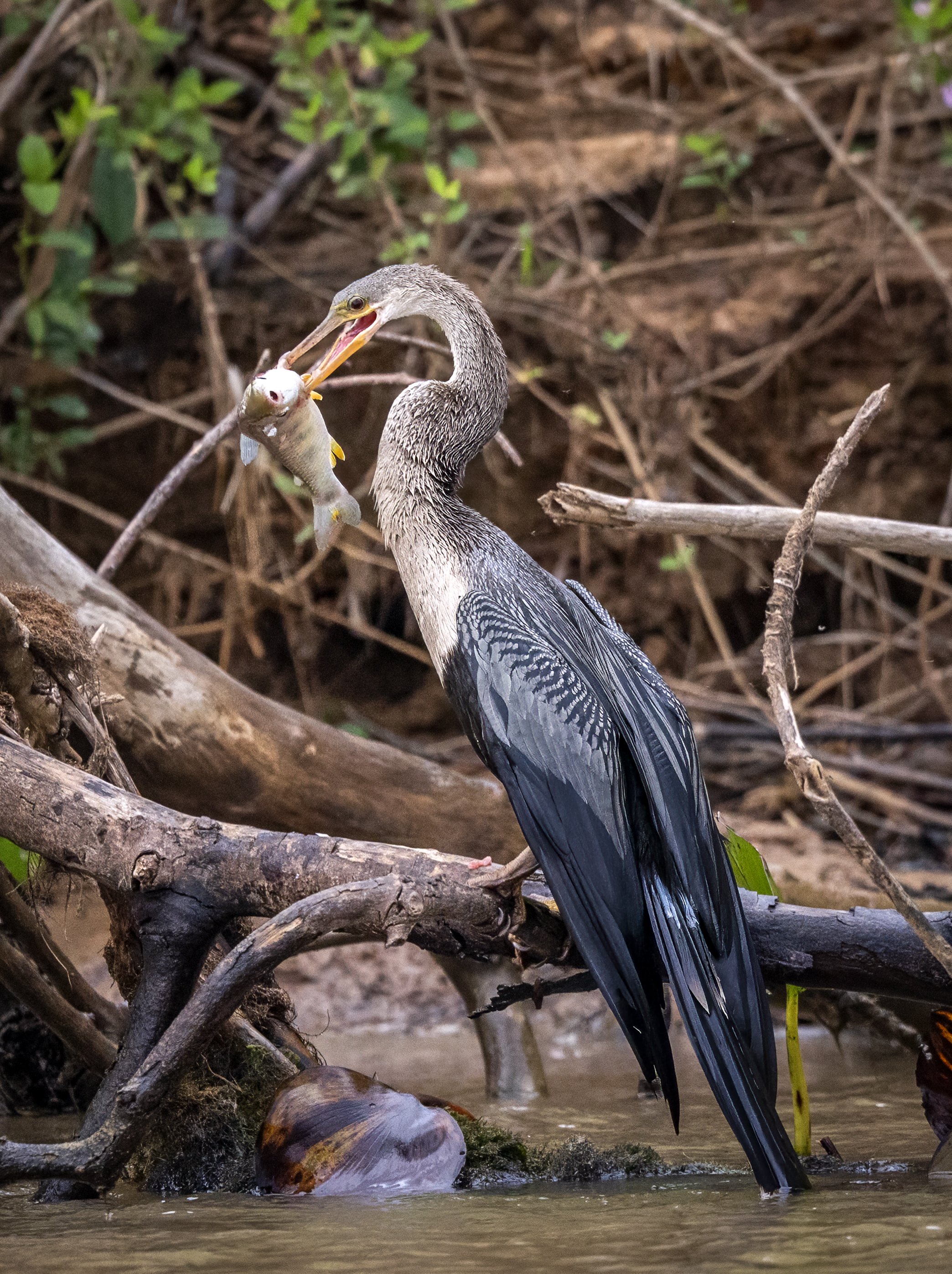
Not a bad way to start.
9:00 AM. Our first jaguar!
Marcela was sitting high on the riverbank, scanning the shoreline for prey.
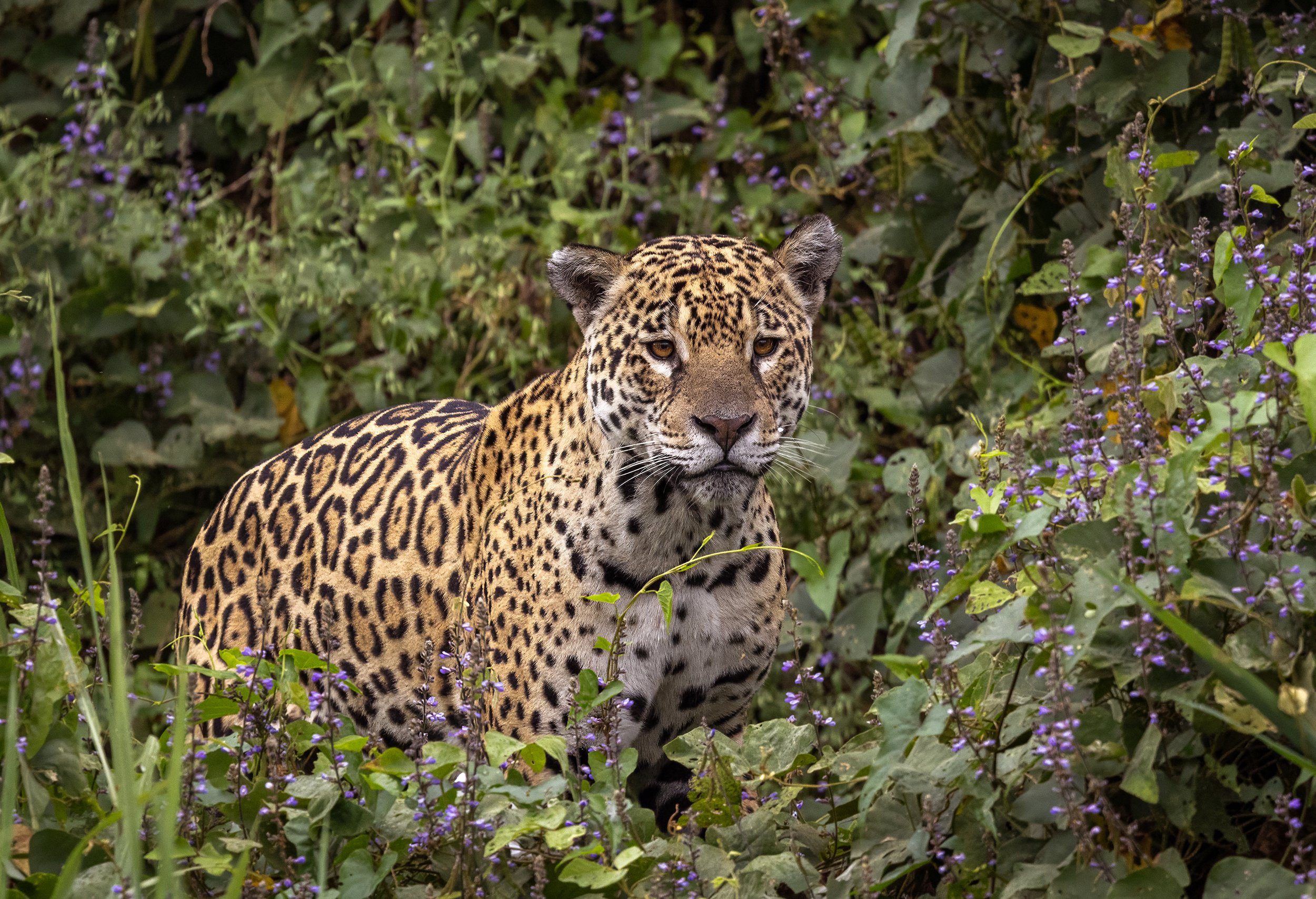
She has two new cubs this season, and we're all hoping to catch a glimpse of them sometime this week.
She got up and walked the river bank, then walked into the river and swam across it.
She climbed up the other side and sat down at another over look, searching for prey.
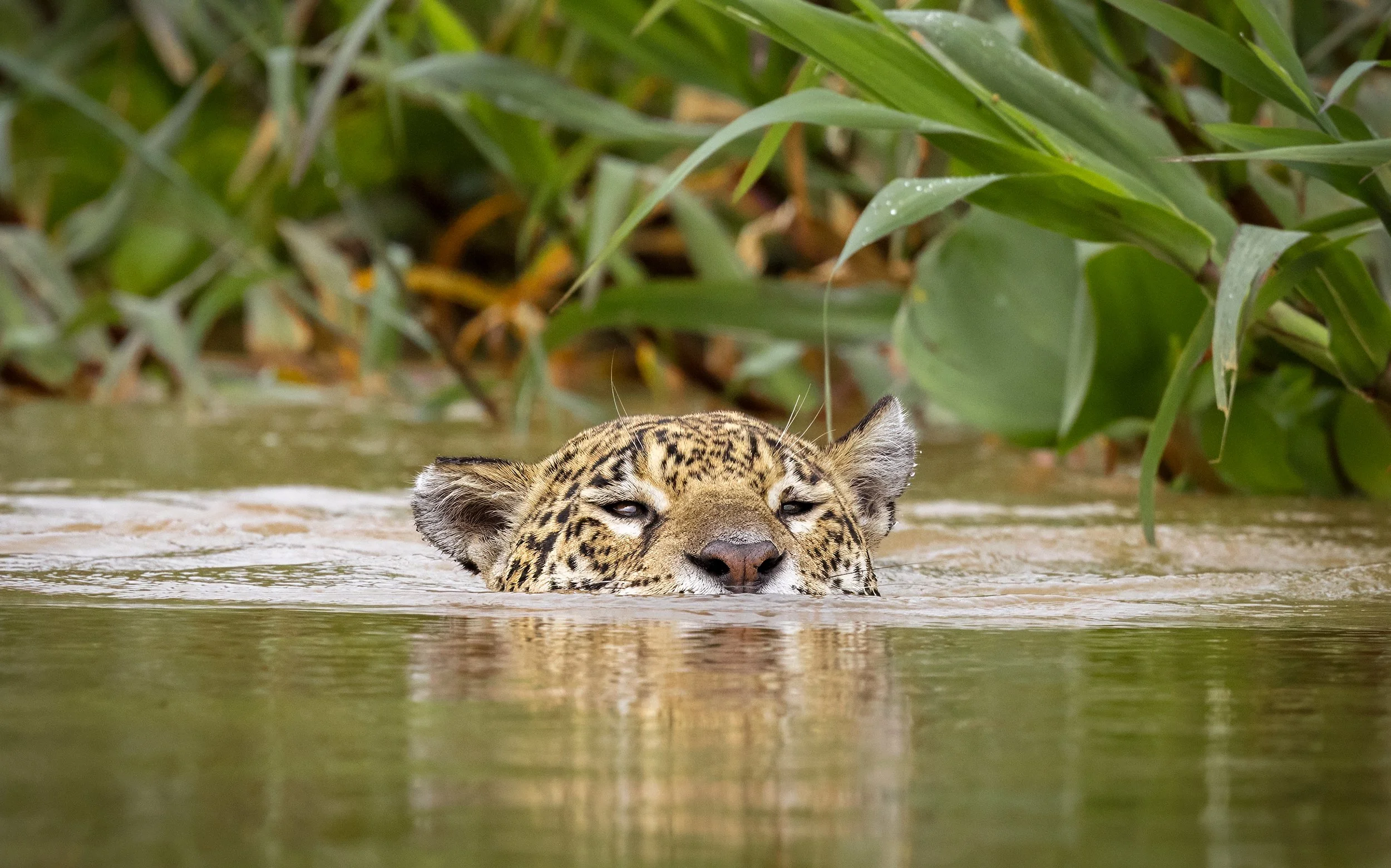
Then the rain arrived.
Marcela disappeared into the brush, looking for shelter, and the rain just poured down.
The first time this has happened to us here.
We have a canopy on the boat, but there's only so much it can do.
We tried to find shelter under a tree, but we were all drenched.
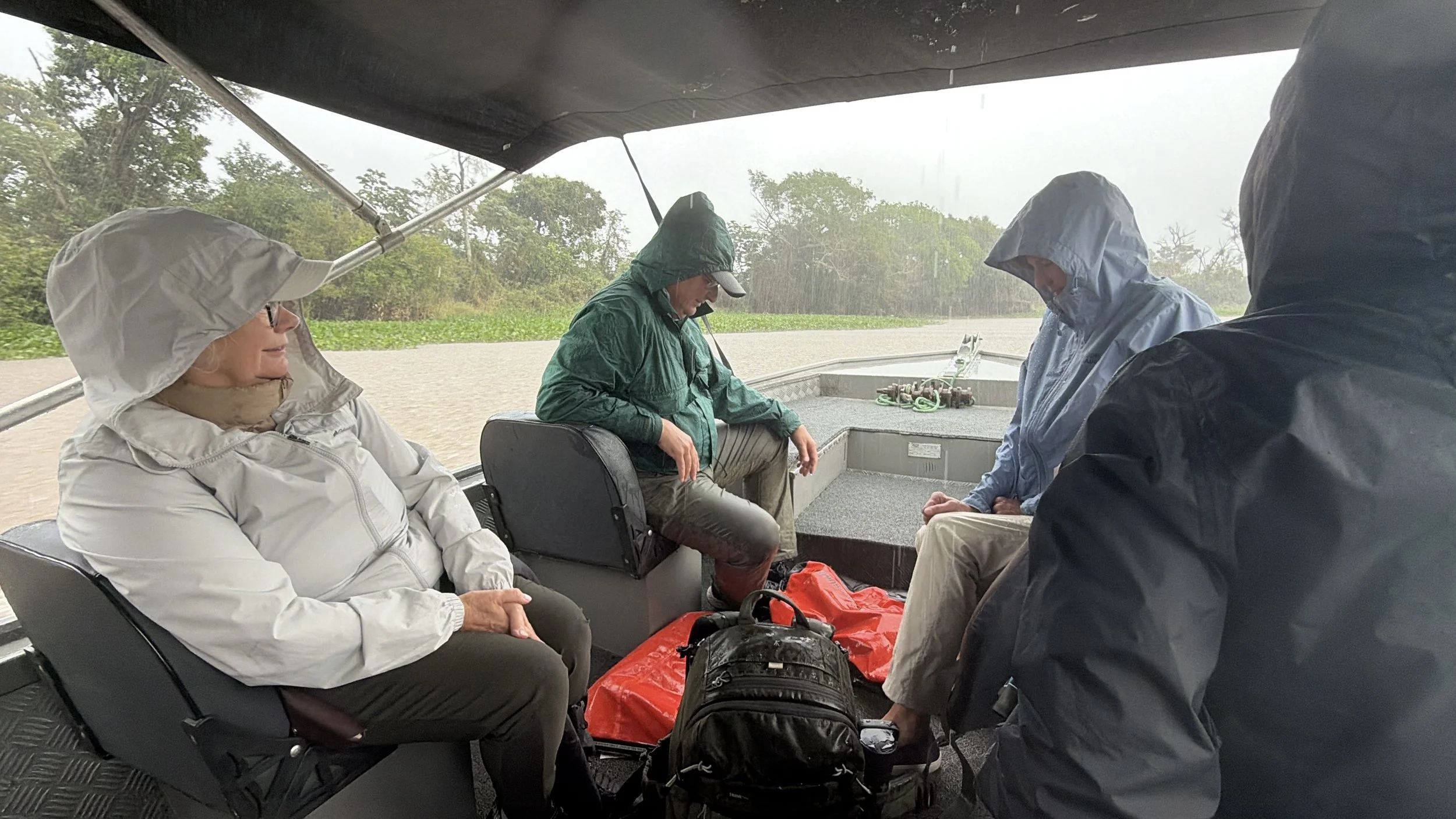
We tried to wait it out, but it wasn't stopping.
Eventually we called it a day and made a run for the dock through the heavy rain.
Ironically, by the time we reached port, the rain had stopped.
Waiting for us near the parking area was a huge family of capybaras grazing peacefully in the grass.
There were babies everywhere.
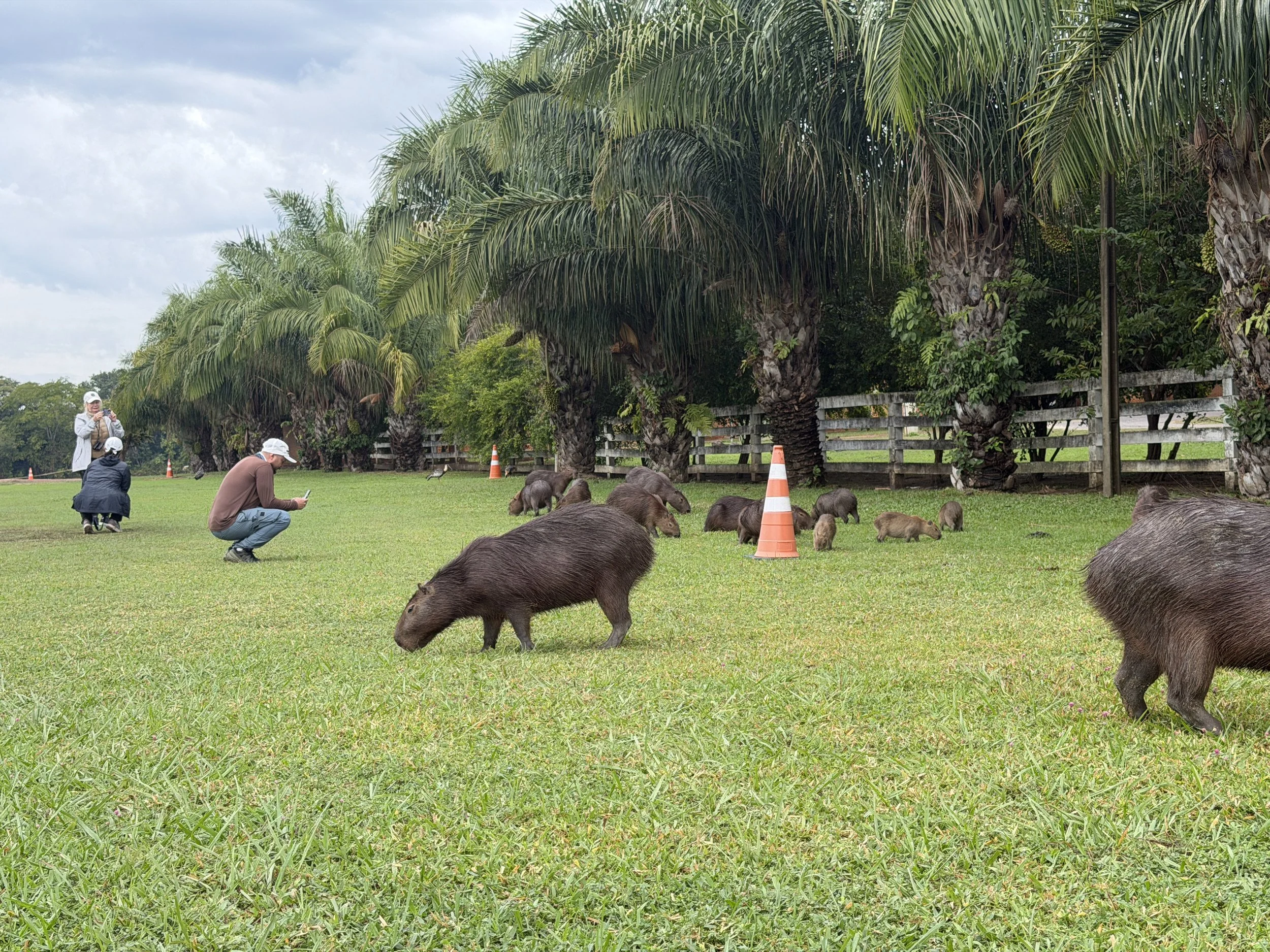
Catherine immediately started trying to figure out how she could sneak one of those cute "babies" home inside her purse.
I don't think Brazilian customs would believe it was a chubby puppy.
As we drove back to the lodge we discovered just how much rain had fallen.
Roads that were dry and dusty this morning had turned into deep mud.
After a few minutes the roads were a bit drier and easier to navigate.
Along the way we stopped to photograph a massive water buffalo feeding in a marsh.
They're impressive animals.
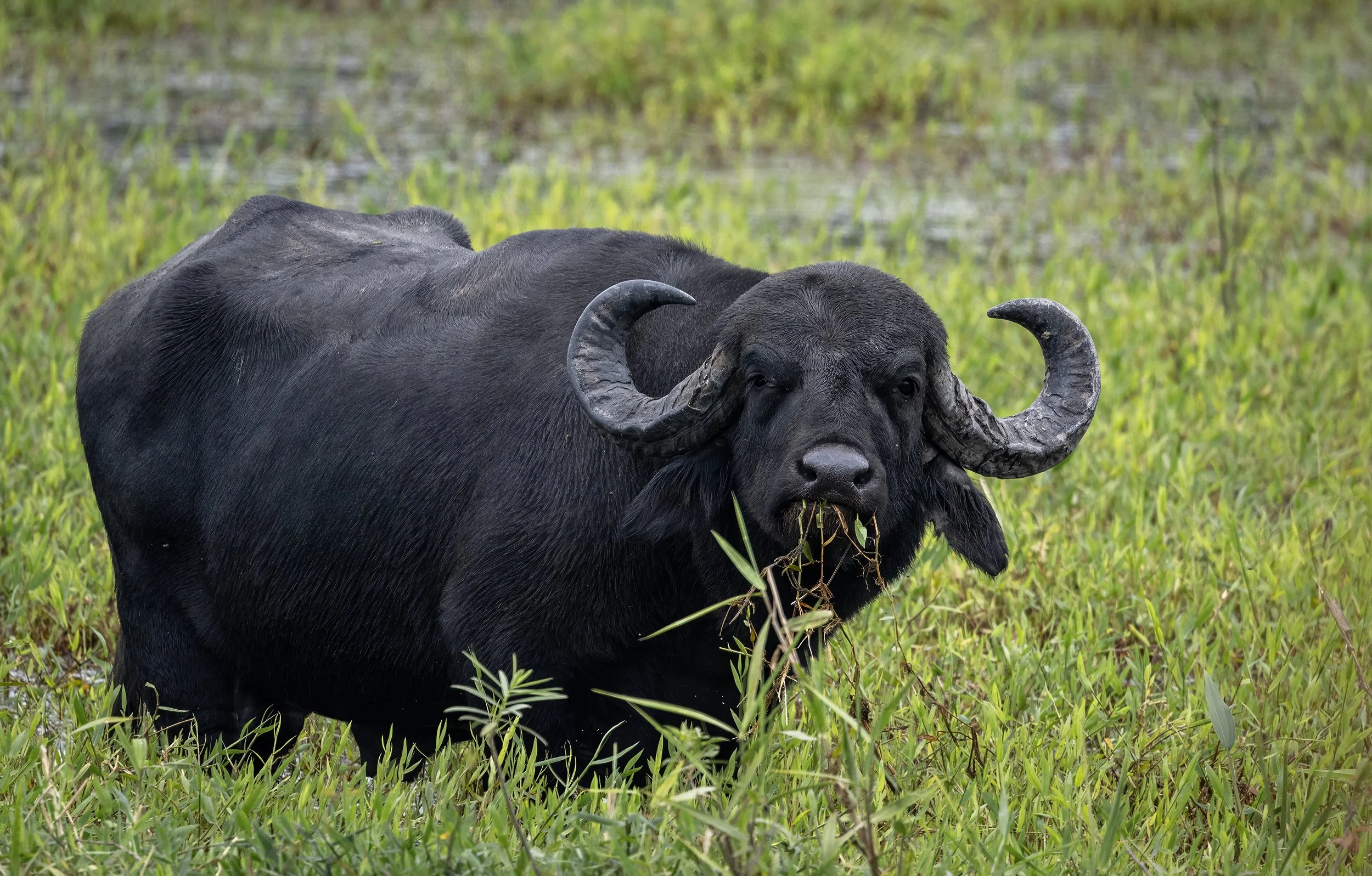
Years ago someone imported water buffalo into the Pantanal hoping to start a ranch. The business failed, but before leaving they released the herd.
Today their descendants roam freely throughout the region.
Many of the locals fear them. The bulls can be extremely aggressive, and they're considered an invasive species, so there is no limit on the number that can be culled.
3:30 PM
Somewhere between the Amazon and the Pantanal I picked up a flu bug.
Mari got it first.
Now it was my turn.
I felt completely drained and seriously considered skipping our afternoon safari.
But then I thought...
What if today is the day we find a black jaguar?
Or a bush dog?
I just couldn’t handle missing that. So I climbed up into the truck.
We didn't find any big mammals that afternoon, but we did enjoy photographing several beautiful birds.
Sometimes that's enough.
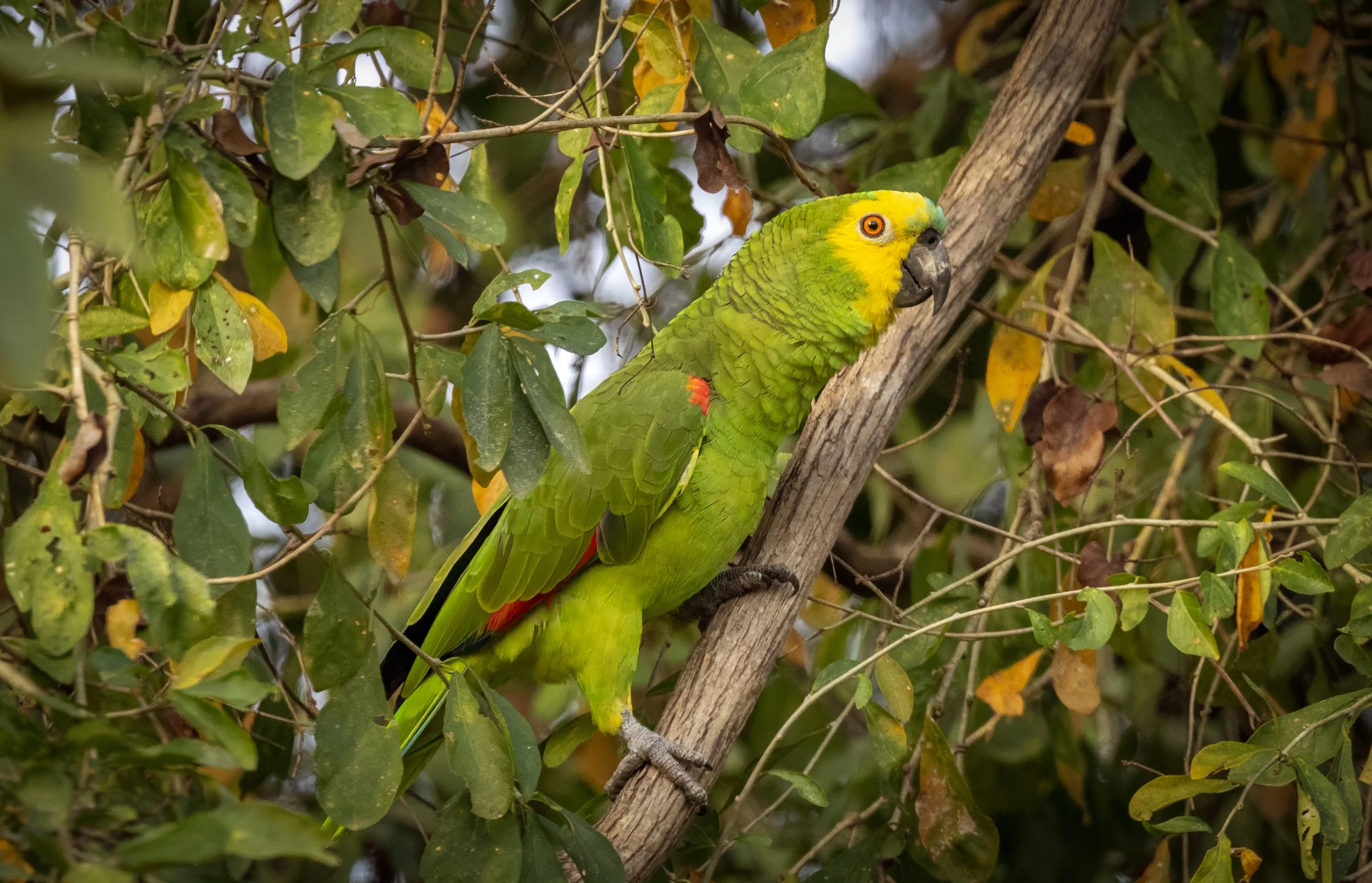
8:00 PM. I was back in my room working on this trip report when I heard an owl calling outside.
Camera in hand, I sprinted outside.
Jean, our local guide and passionate birder, was already there, spotlight pointed high into a tree.
There it was.
A great horned owl.
I raised my camera and fired...
"No card."
Damn it!
I’d forgotten to put the memory card back after downloading the day's photos.
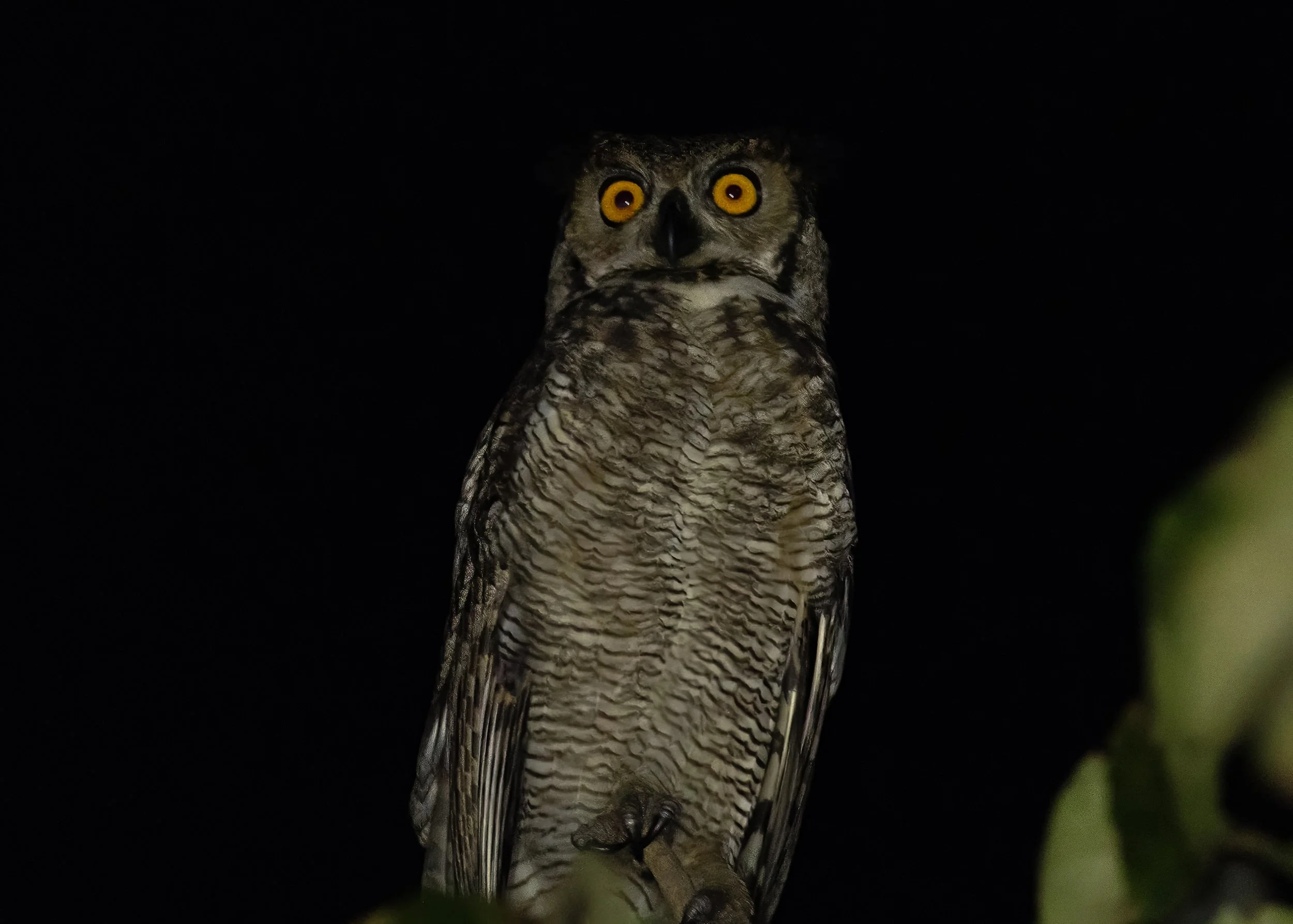
I ran back to my room, grabbed the card, sprinted outside again, and managed three proof of life frames before the owl silently disappeared into the darkness.
Then Jean spotted something else.
A pair of crab-eating foxes wandering across the property.
We followed them until one caught a snake.
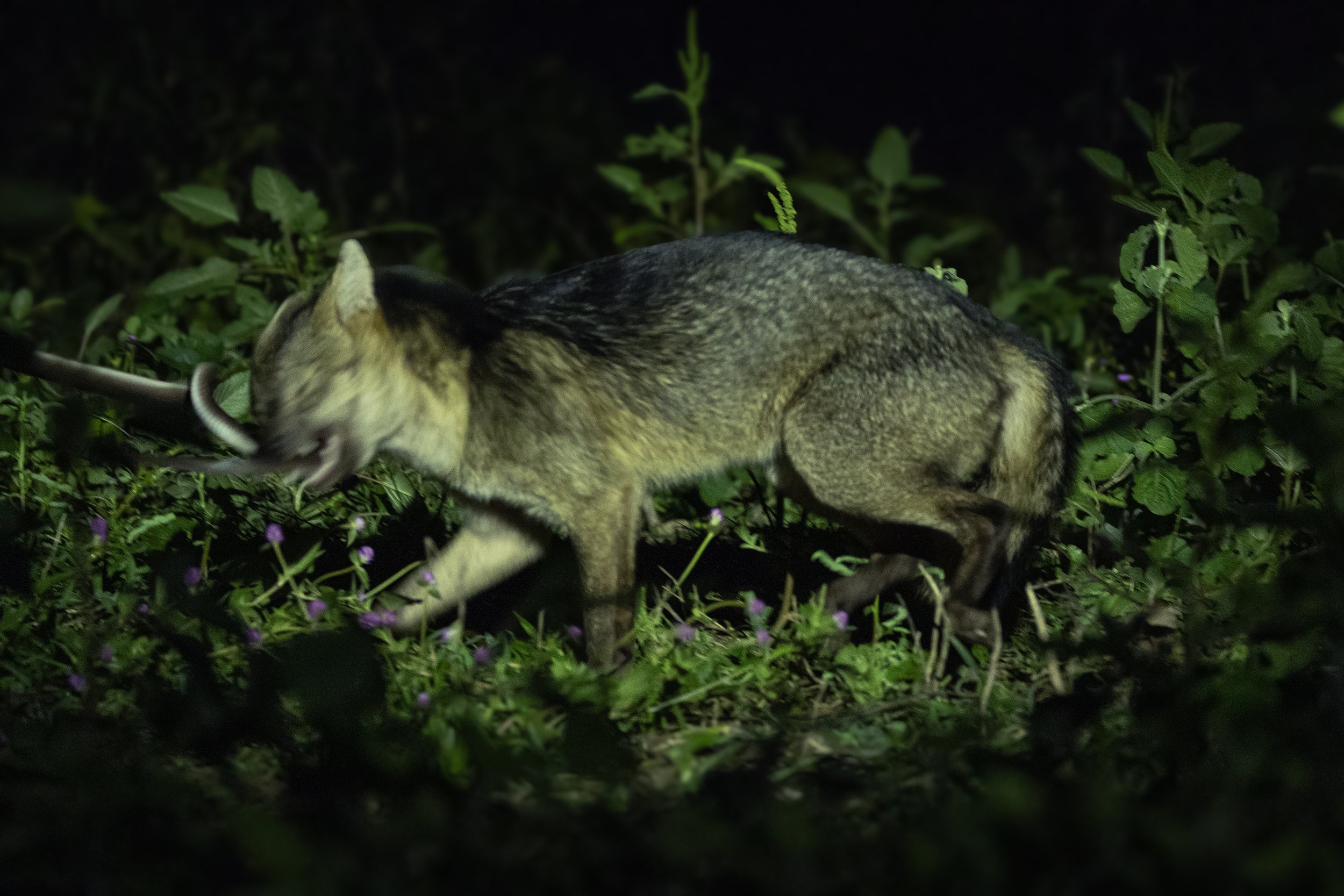
crab eating fox killing the snake. It was shaking his head violently and my camera’s shutter speed was 1/250, so the image is not sharp of course. But this is still fun capture.
I kept trying to photograph the fox picking it up, but every time I lined up the shot, it would drop the snake and disappear into the brush.
We waited, and waited.
The mosquitoes finally won the battle.
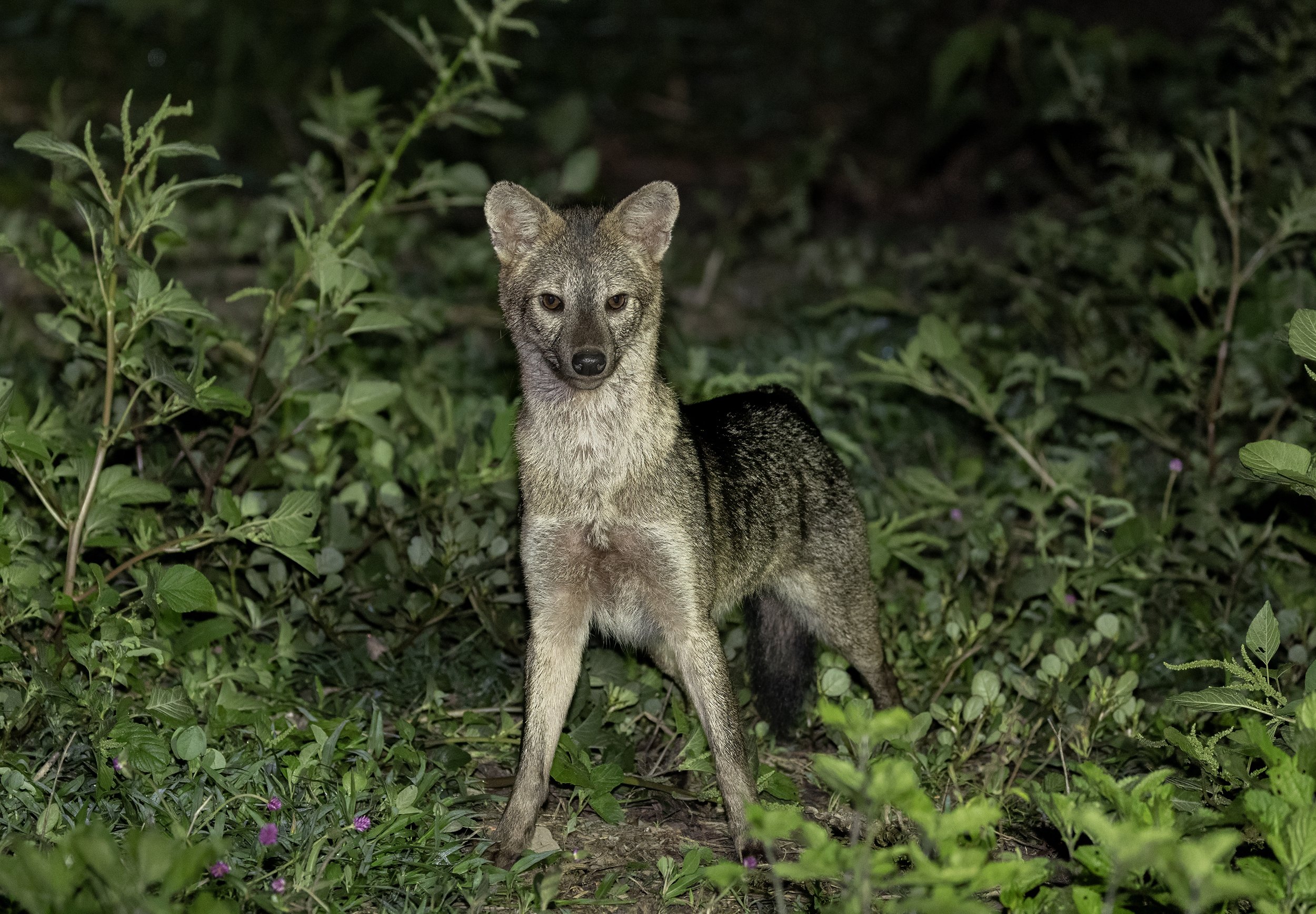
We headed back to our rooms.
It wasn't the easiest day.
The rain interrupted our search.
The flu drained my energy.
But we found our first jaguar, photographed a beautiful owl, watched a big family of capybaras, and ended the evening with some crab-eating foxes.
I'd call that a pretty good first day in the Pantanal.
July 13, 2026. Day Two
Wildlife Seen Today.
✔ Marsh deer
✔ Crab-eating fox
✔ Jaguars (4): Medrosa, Bororo, Ousado, one unidentified
✔ Giant river otter
✔ Brazilian porcupine
✔ Howler monkeys
✔ Ringed kingfisher
✔ Amazon kingfisher
✔ Jabiru stork pair on nest
✔ Long-nosed bats
✔ Green iguana
✔ Baby caimans
The day began with a marsh deer and a crab-eating fox along the road to the river.
Unfortunately, my camera settings were still set from last night's owl photography, so by the time I realized what I'd done, I'd already blown the first few shots of the deer as it stood there posing perfectly for us.
Not the start I had in mind.
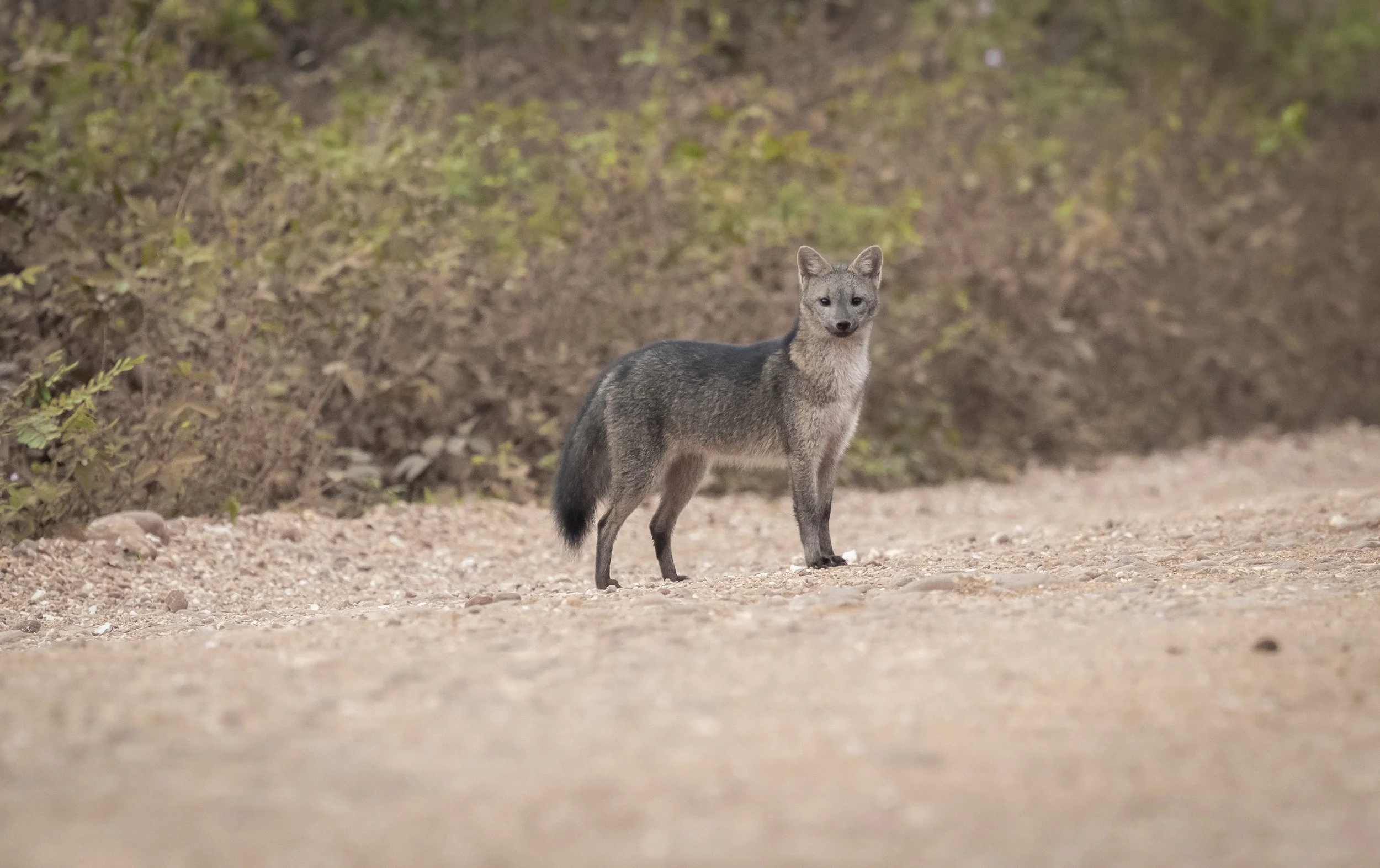
8:48 AM
Our first jaguar of the day.
It was Medrosa, she is Marcela’s mother. The female cat we saw yesterday.
She was sitting high on the riverbank, completely focused on something hidden in the vegetation below.
One thing I love about the Pantanal is the annual jaguar guidebook produced by the local researchers. It identifies roughly fifty individual jaguars that regularly use these rivers.
Mari absolutely loves flipping through it each day, matching names and faces with the cats we encounter.
It's become one of her favorite parts of the trip.
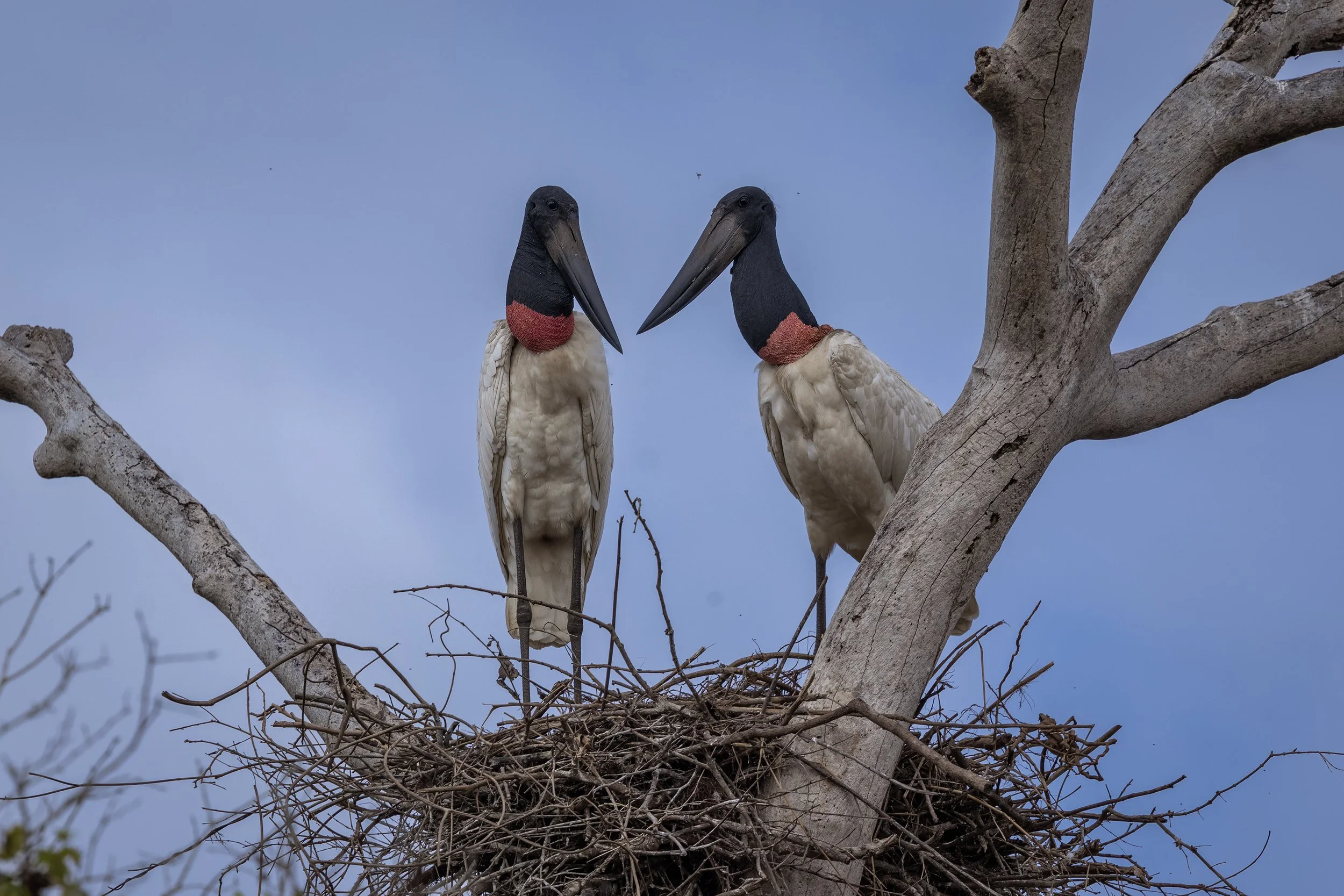
A little farther downriver we stopped to photograph a pair of jabiru storks standing high in a dead tree on their nest.
No chicks yet.
Soon.
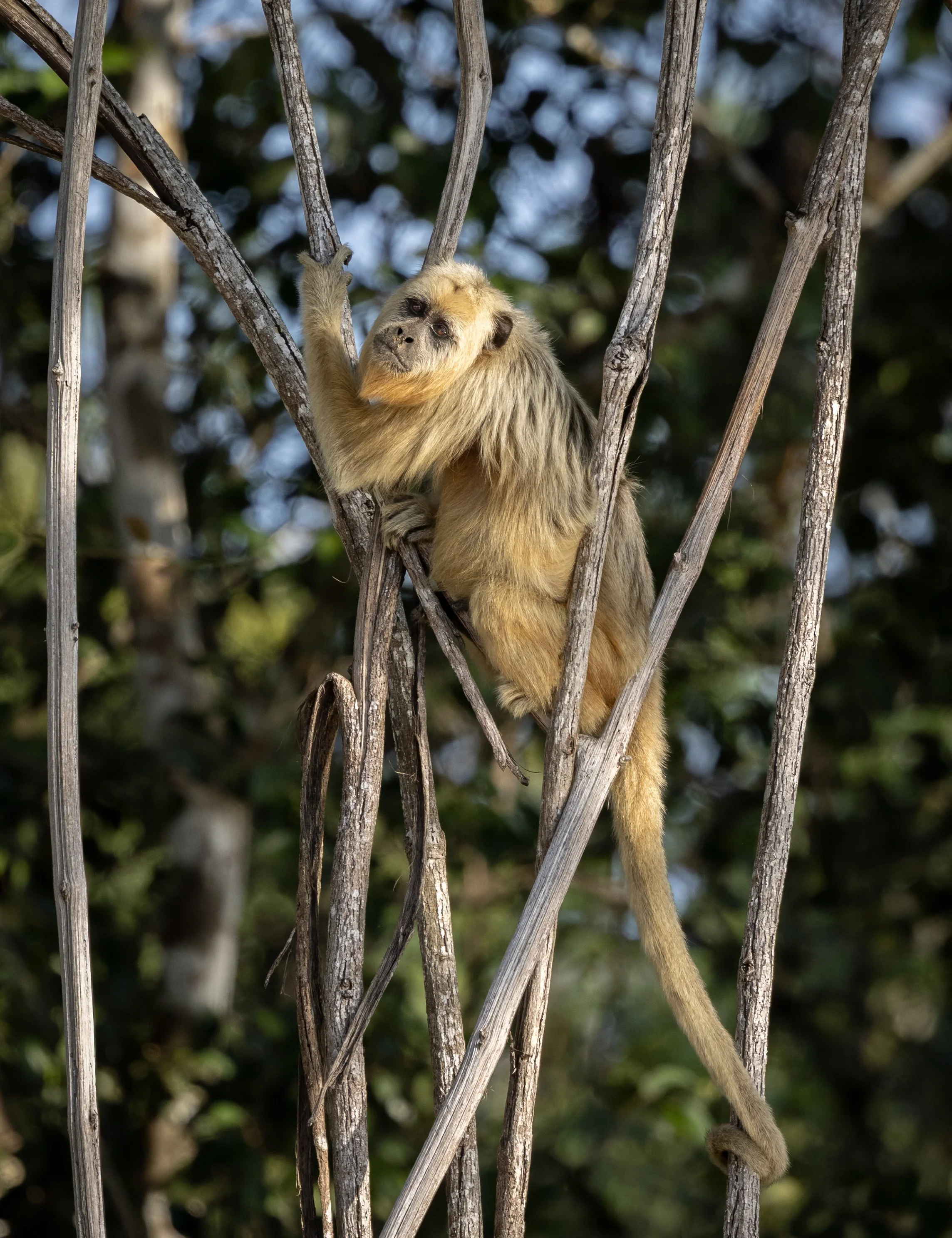
Our next stop was a troop of howler monkeys.
The light was terrible, so today's images will mostly serve as proof they were there rather than portfolio shots.
Then came one of my favorite sightings of the day.
A Brazilian porcupine.
It was curled up high in a tree, sleeping peacefully through the daylight hours.
Like most nocturnal animals, it had absolutely no interest in waking up for photographers.
I desperately wanted a photograph of its face, but it remained tucked in tight.
We continued searching for jaguars, but I made a mental note to come back later.
Hopefully it would move.
Thankfully... It did.
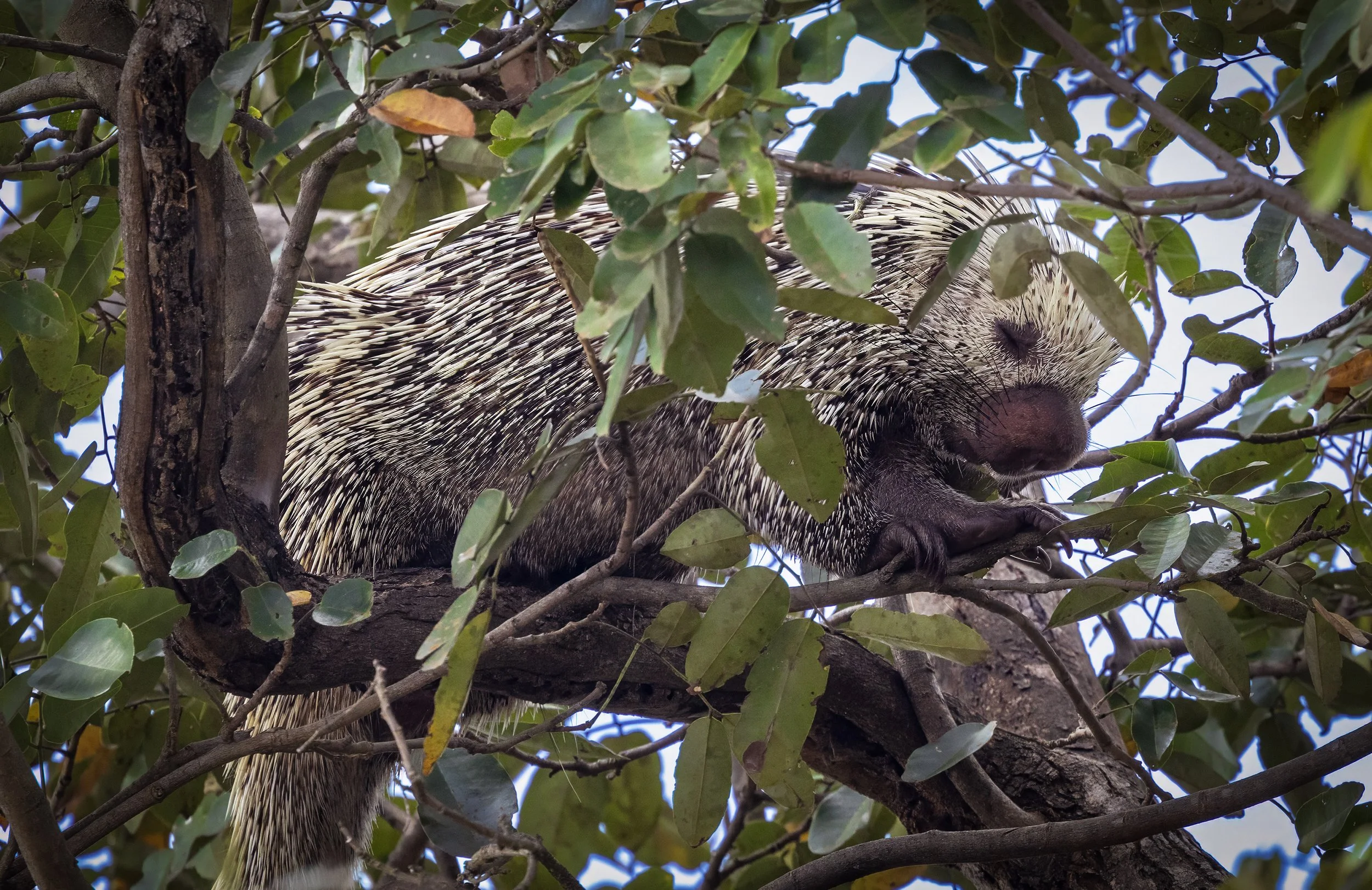
When we returned, our sleepy porcupine had shifted just enough to give us a clear look at its face.
There were still a few leaves in the way, but it was more than enough.
I was on fire.
This animal is extremely hard to find.
The jaguars were proving much harder to find today.
By late morning only three different cats had been reported.
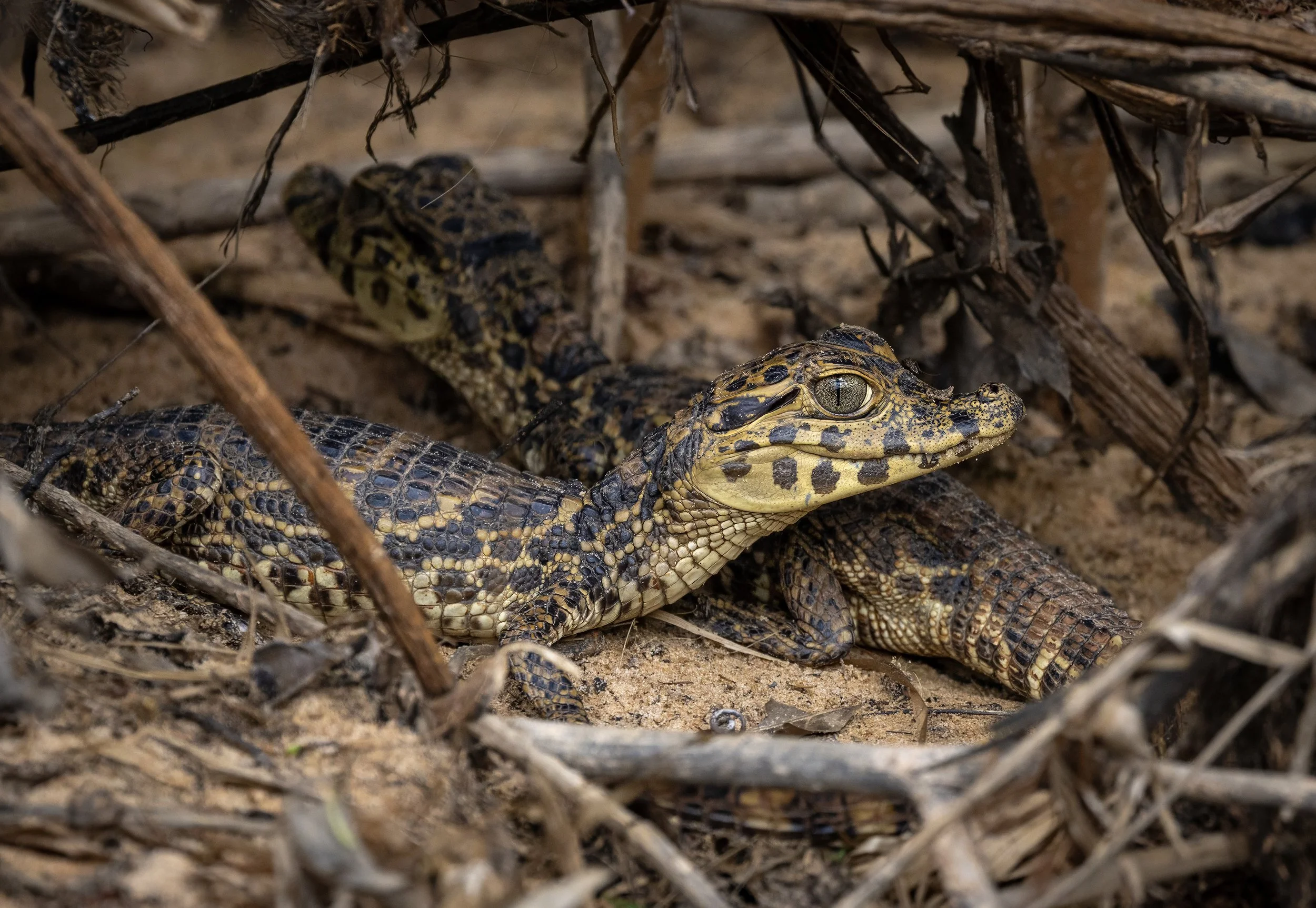
During a quick bathroom stop along the riverbank we noticed a female caiman guarding dozens of tiny hatchlings hidden among the vegetation.
They were almost impossible to see.
Tiny.
and super cute!
Our second jaguar of the day was Bororo, a huge male.
He stepped into the river, swam for a short distance, climbed the opposite bank, and disappeared into the forest.
The captain suspected he was crossing into another river system.
While we waited, a ringed kingfisher landed nearby holding a huge fish in its bill.
Earlier we'd photographed an Amazon kingfisher doing exactly the same thing.
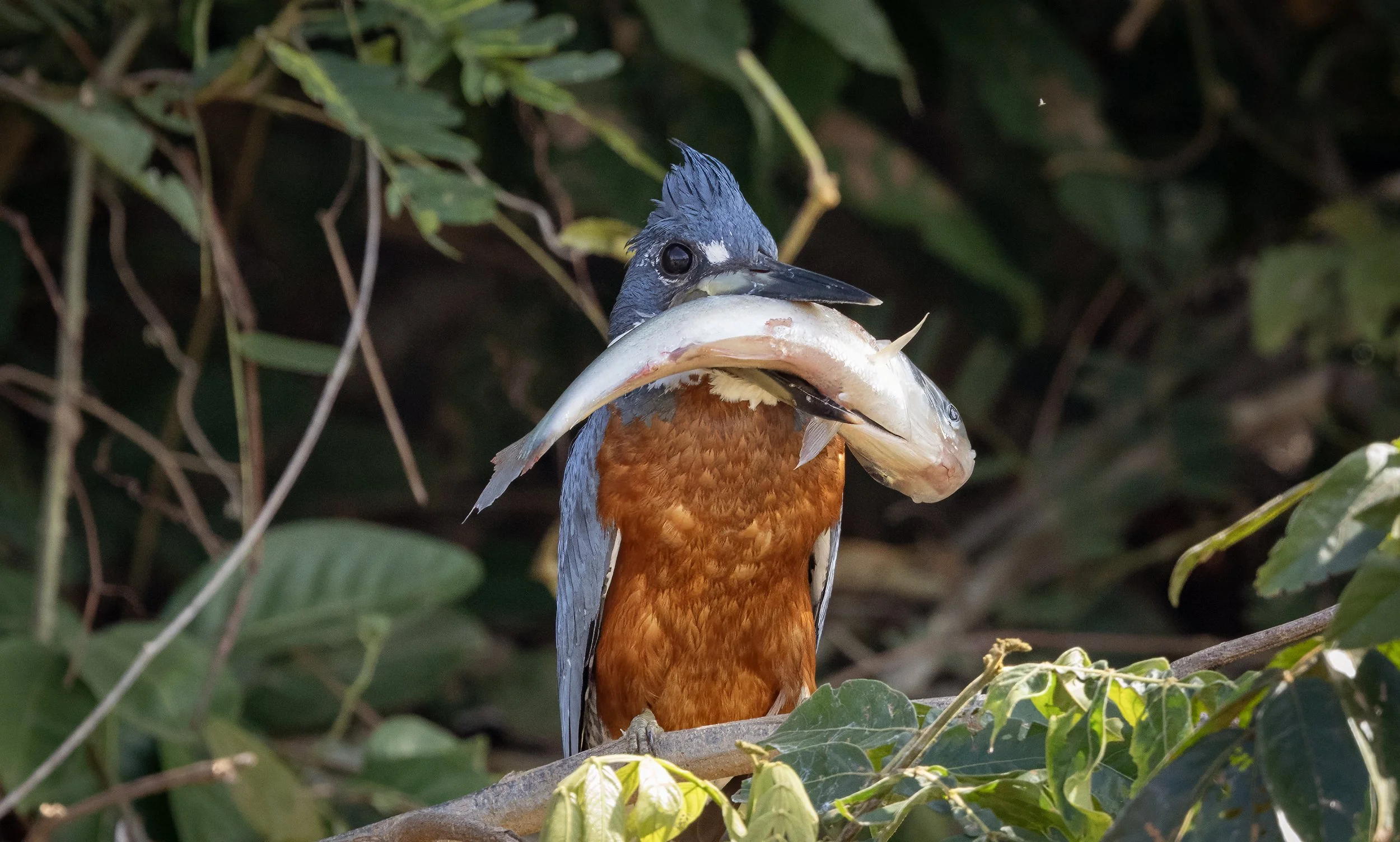
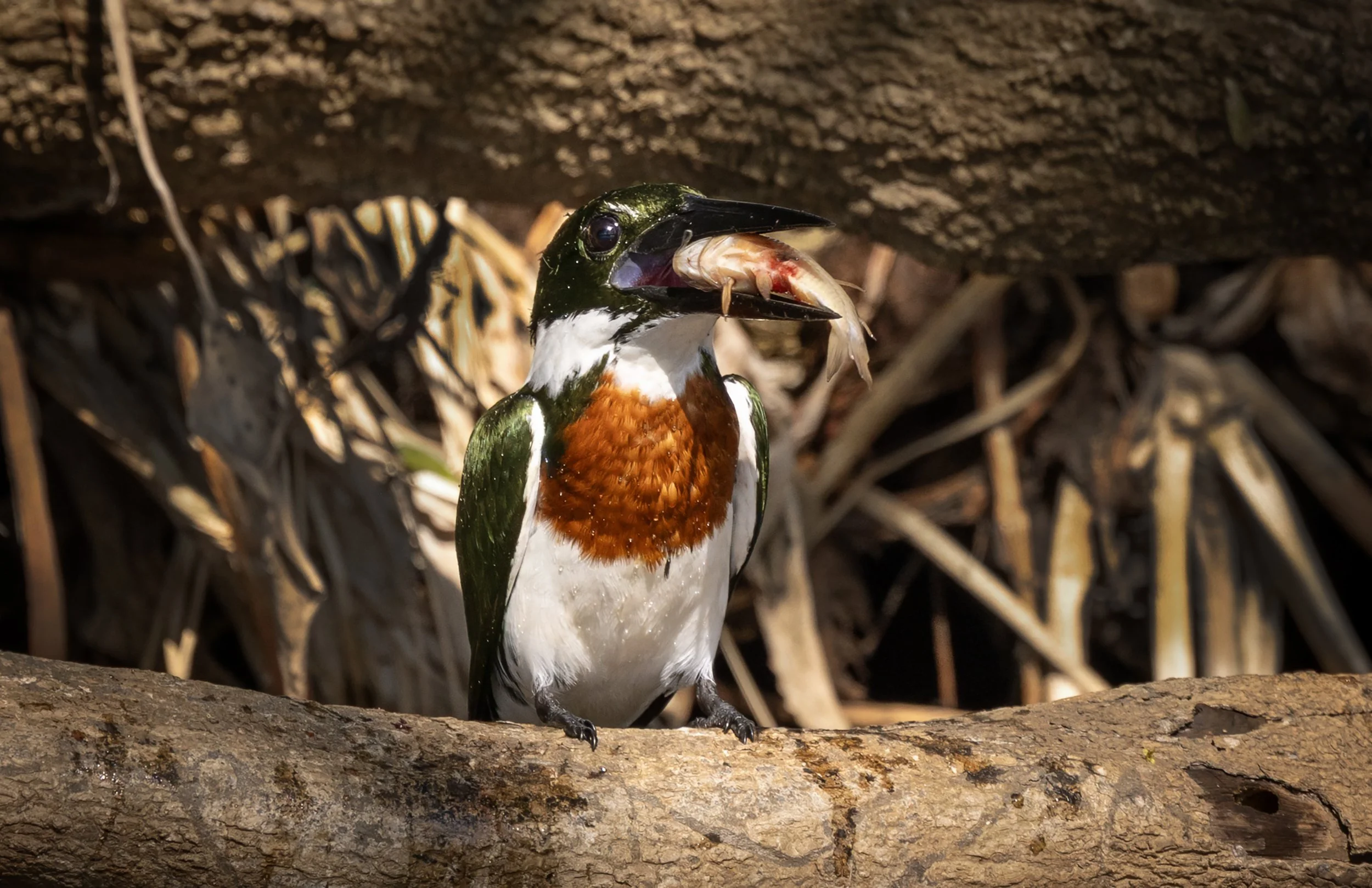
Kingfishers never disappoint.
Not long afterward we visited a tree where several long-nosed bats roost almost at eye level.
Cute little things.
Then Bororo surprised us.
He suddenly emerged onto a sandy beach only a short distance from our boat.
Everyone scrambled for their cameras.
He is an awesome cat. Huge male in his prime.
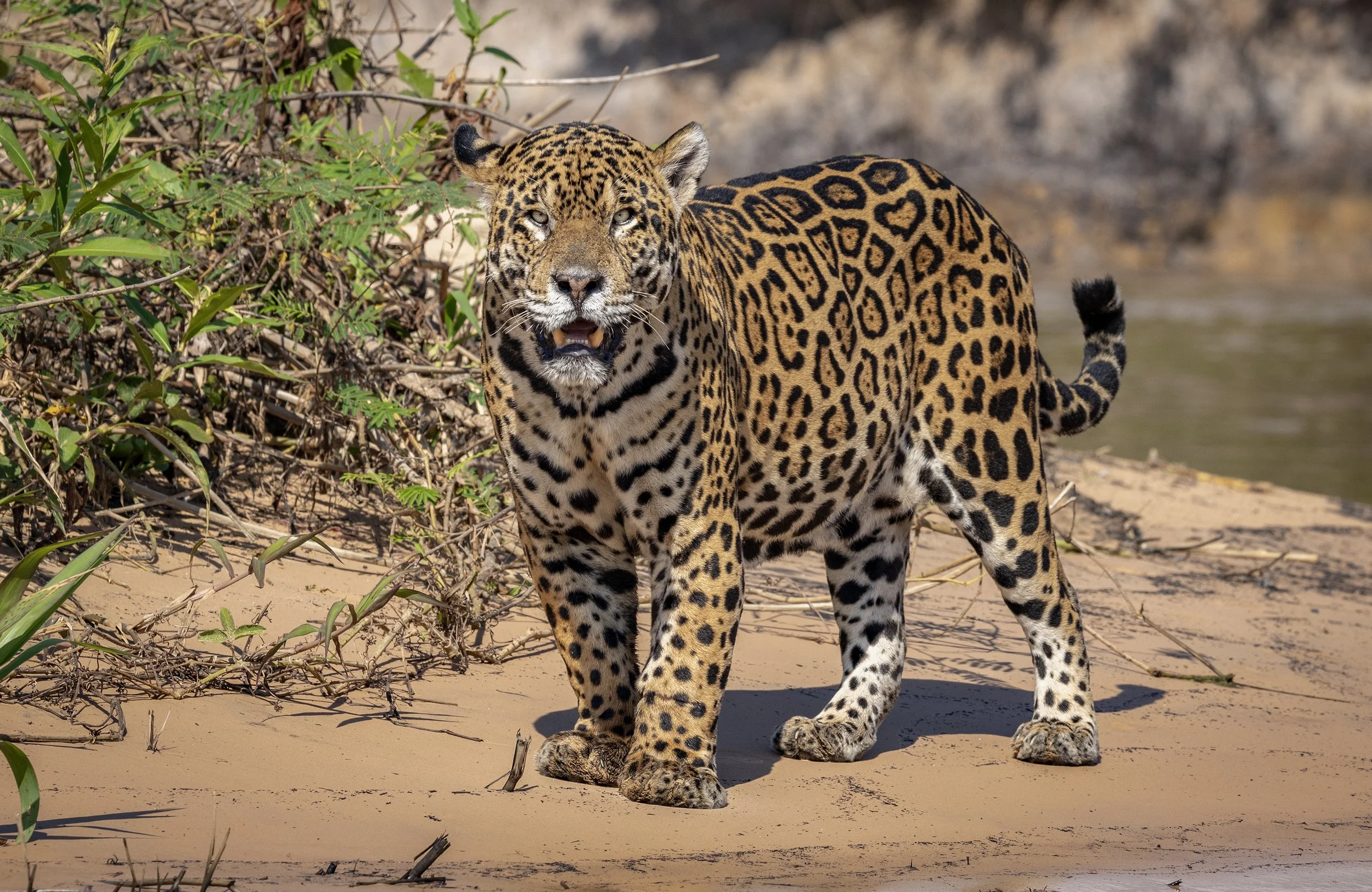
After a few minutes he calmly swam across the river and disappeared back into the forest.
We lost Bororo...
...but quickly found another jaguar tucked deep beneath thick shrubs.
Unfortunately we couldn't identify this one.
While we were waiting for the cat to come out, we got a report of another cat over the radio.
Off we went again.
2:00 PM
On the way we stopped for another troop of howler monkeys.
One female was carrying a tiny baby on her back while feeding out in the open.
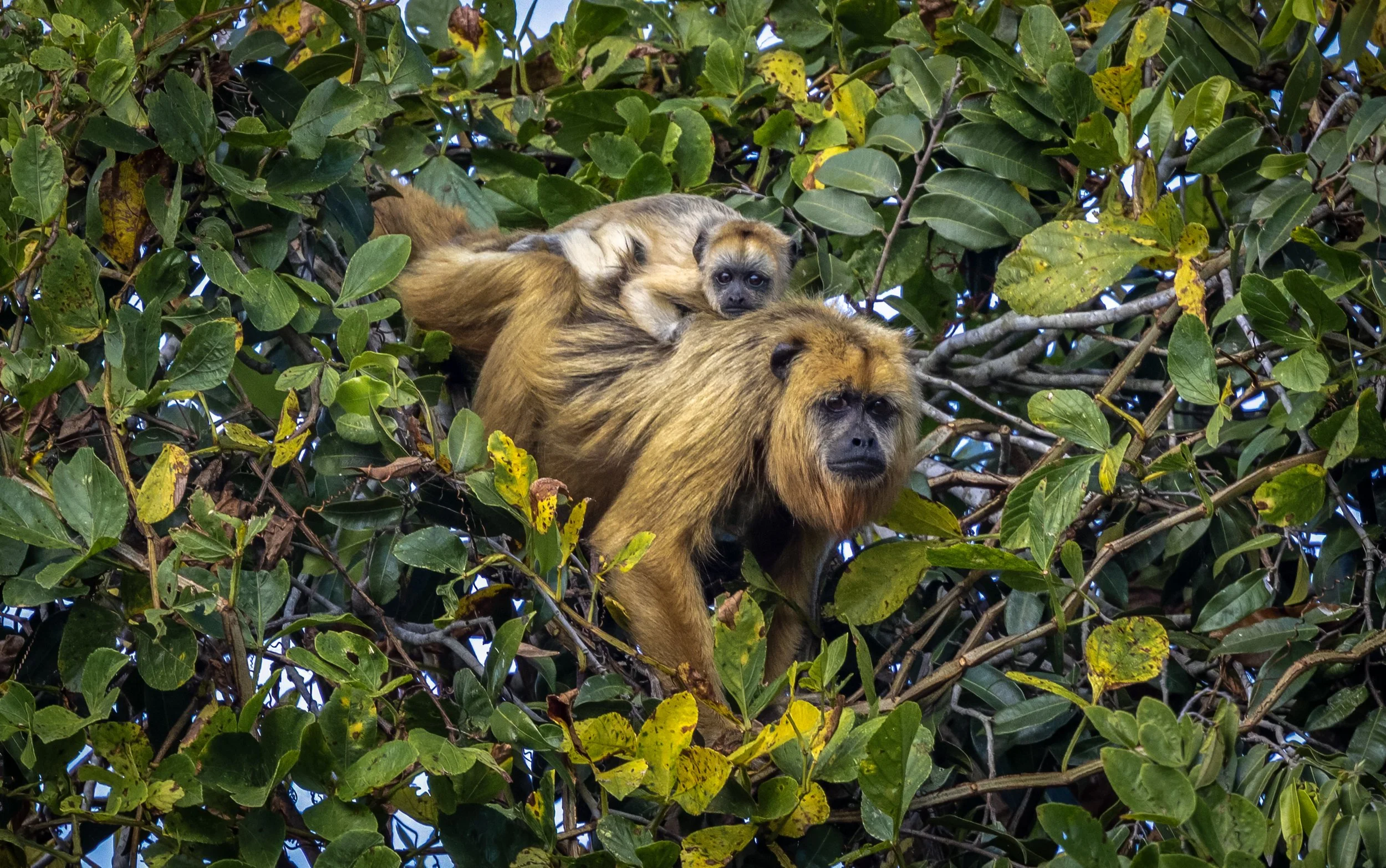
If the photograph turned out the way I hope it did...
It may be my favorite howler monkey image I've ever made.
Our fourth jaguar of the day was Ousado.
He is a large male wearing a GPS tracking collar.
He was badly burned during the Pantanal fires several years ago and was rescued and treated before being released.
Today the collar allows researchers to continue monitoring his recovery.
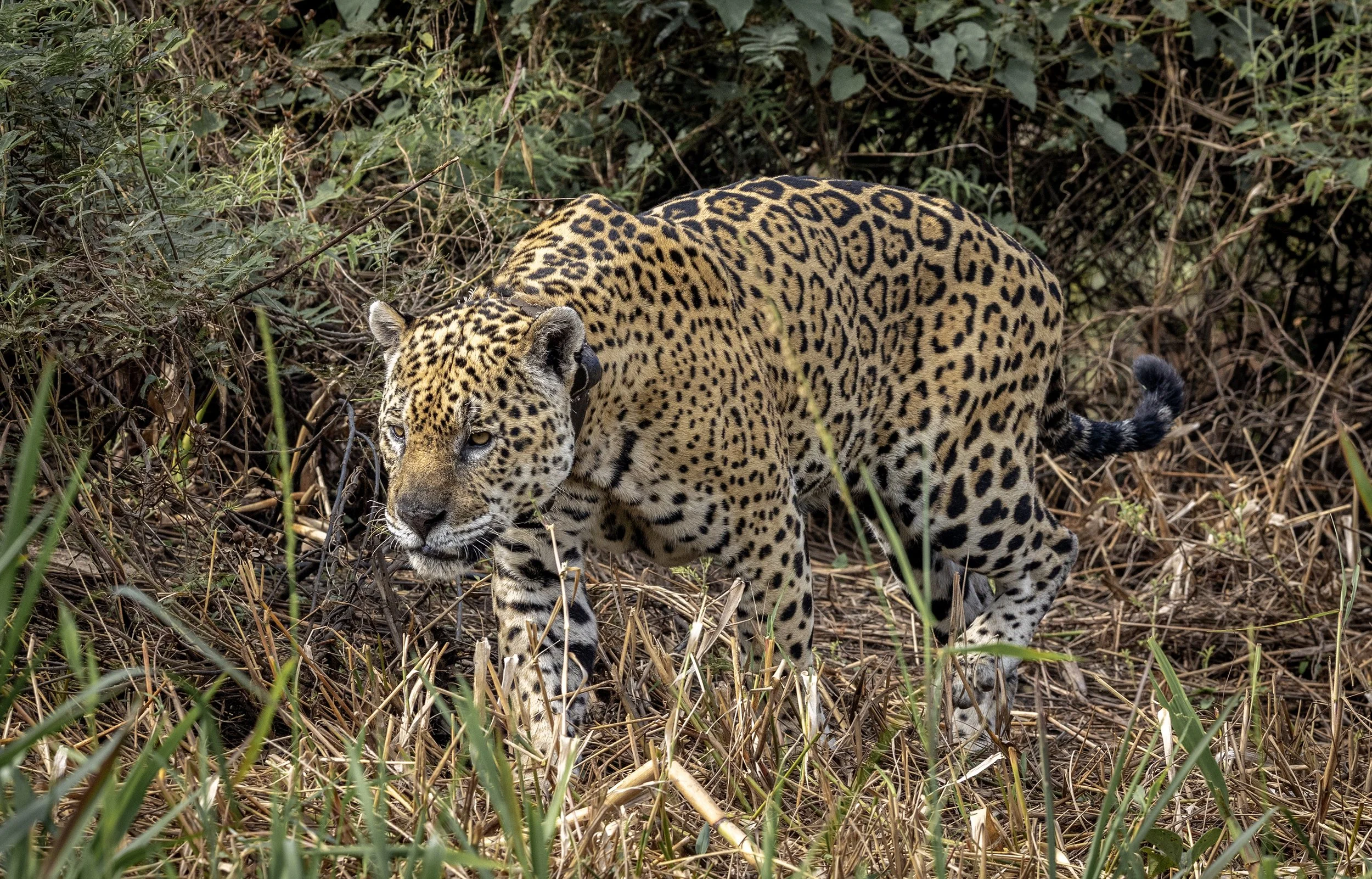
He's also famous for something else.
He's our "diving jaguar."
When hunting, Ousado has been seen diving completely underwater before surfacing beside his prey.
It's a hunting technique unlike anything we've seen from the other jaguars here.
An extraordinary cat.
Later in the afternoon we found a lone giant river otter.
Normally they're surrounded by family members.
This one seemed to be searching...
Swimming up and down the river without the usual playful behavior.
It almost looked lost.
Our final wildlife encounter came from another troop of howler monkeys.
They had climbed down to the river for a drink.
As our boat approached, they quietly began climbing back into the forest, giving us some wonderful opportunities to photograph them ascending the vines.
After that encounter we decided to return to port, it had been a very long day and everyone was tired.
Can’t wait for tomorrow!
July 14, 2026. Day Three.
Wildlife Encounters Today
8 Jaguars (Marcela, Patricia, Osado, Pantanero, Medrosa, Saseka, Apeiara, Oriel)
Caiman with butterfly
The morning began under clear blue skies.
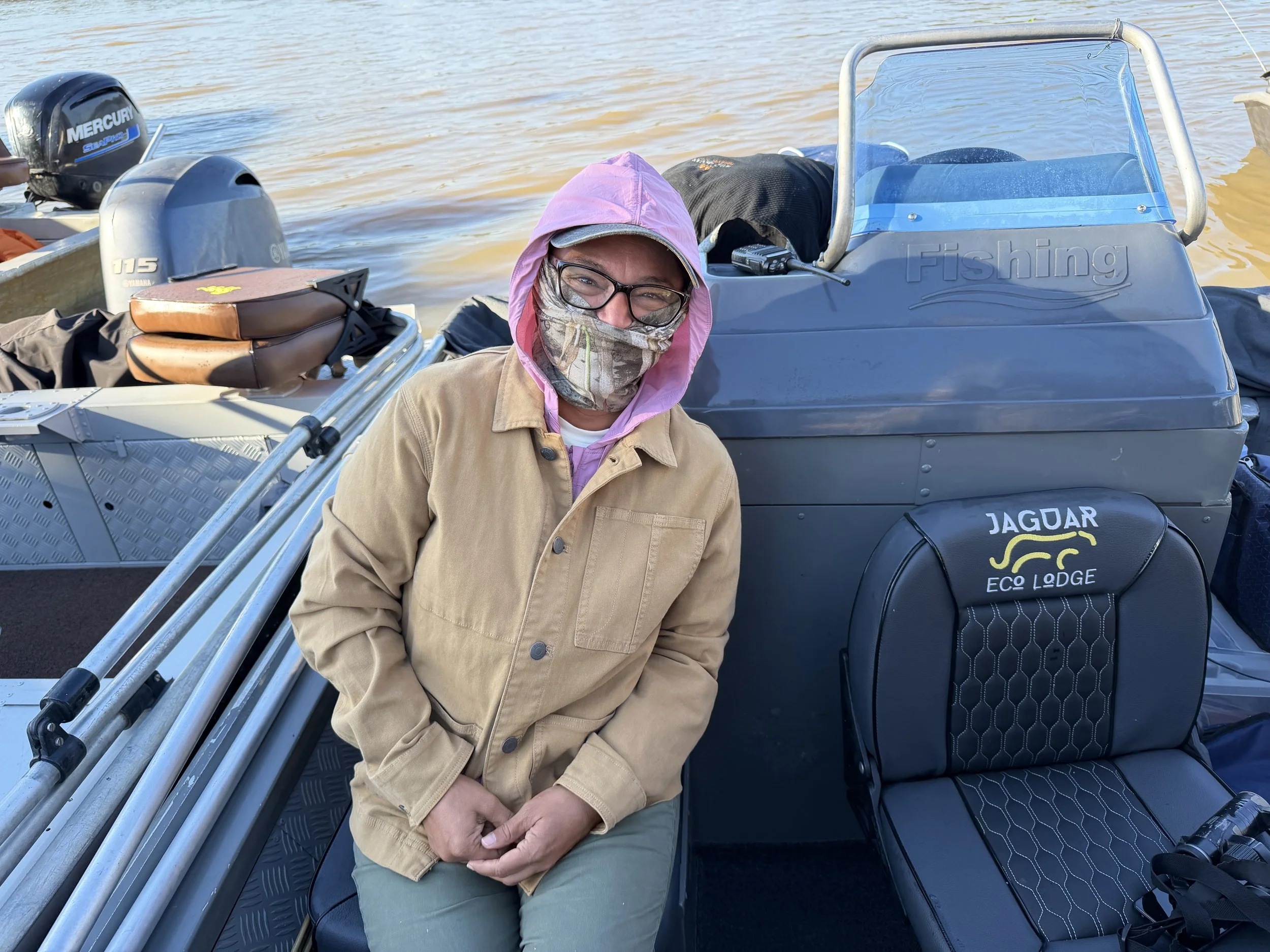
It was a very chilly morning, and Mari was bundled up so much she looked ready to search for polar bears instead of jaguars on the equator.
It wasn't going to stay that way for long. The forecast promised another hot Pantanal day, perfect for wildlife activity along the river.
Our first encounter was Marcela. When we found her, she was stalking a capybara sitting in the water.
The capybara saw her, then dove underwater and swam away to safety.
She had moved a considerable distance from where we had first found her earlier in the week. With two young cubs hidden somewhere nearby and several large males roaming the area, relocating made perfect sense. She spent the morning methodically working the riverbank, hunting but coming up empty.
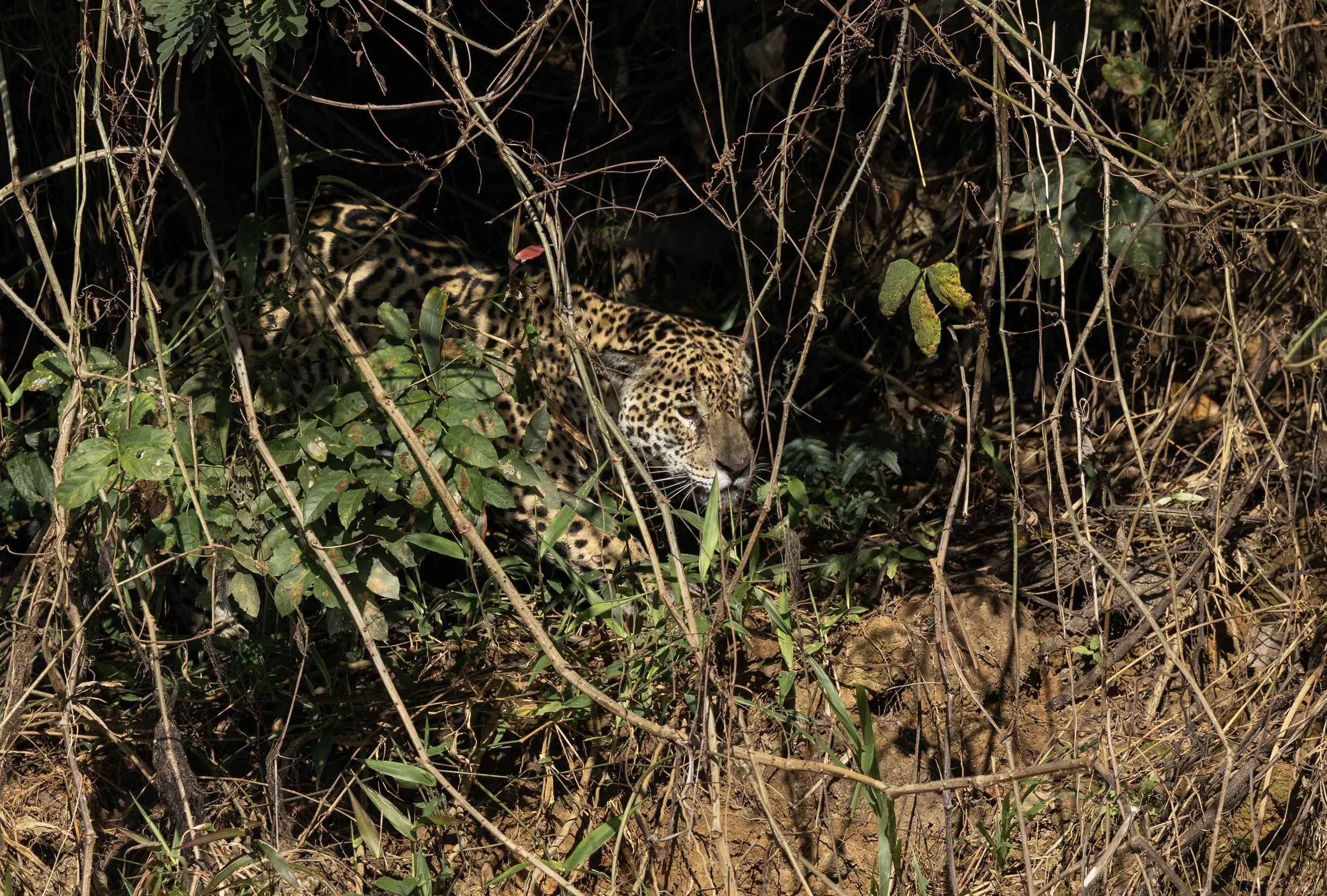
As more and more boats gathered around her, we decided to leave the area to find our own jaguars.
Our next jaguar was Patricia.
Patricia is one of the matriarchs of this river system. She is Medrosa's mother, Marcela's grandmother, and the sister of the famous Bororo, although they were born in different litters. Patricia is now fifteen years old, while Bororo is ten.
One thing I continue to love about this place is that these aren't just anonymous jaguars. They are individuals with histories, family trees, territories, and personalities that researchers have documented for years.
The harsh midday light wasn't ideal for photography, so I simply enjoyed watching Patricia hunt.
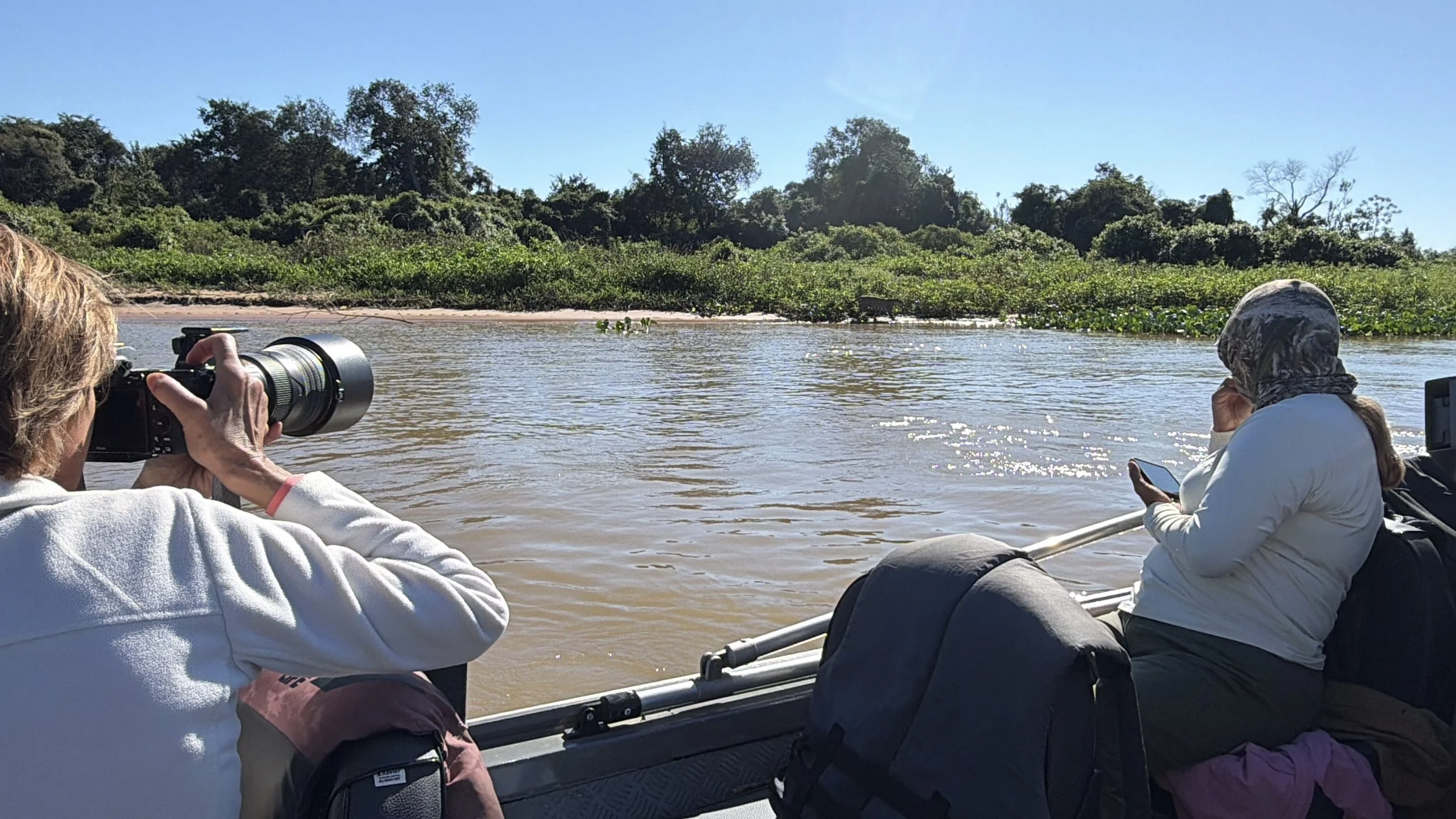
Later we learned she had successfully killed a caiman deep in the tall grass, hidden completely from view.
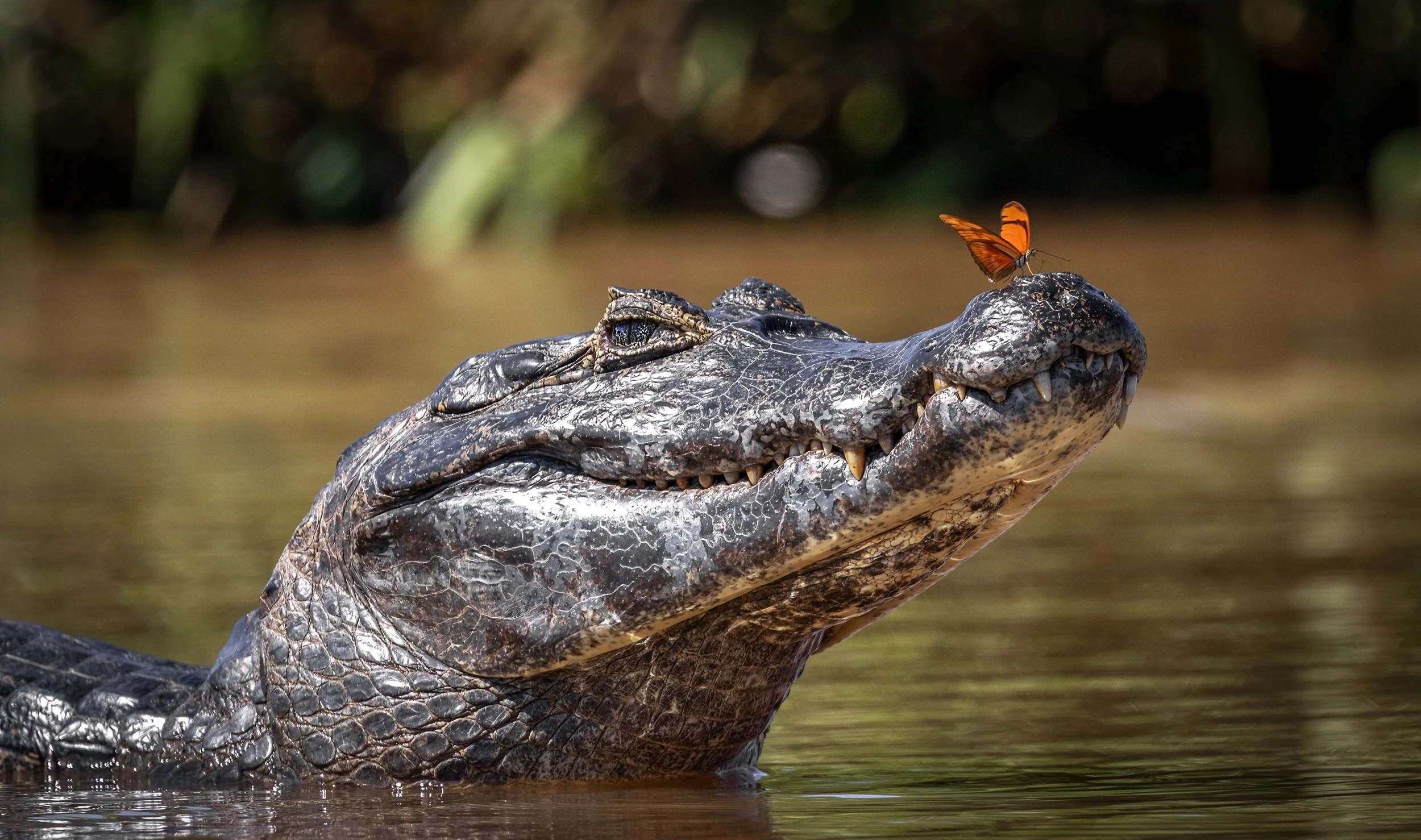
A few days ago I mentioned how much I wanted to photograph a caiman with a butterfly resting on its head.
Today it happened.
A caiman lay motionless in the sun while a beautiful butterfly drifted around its face, landing repeatedly near its eyes and nose, likely collecting salts. It was one of those quiet little moments that few people ever notice, yet it became one of my favorite photographs of the day.
After lunch, another unforgettable sequence unfolded.
A few boats slowly approached our lunch spot.
The reason became obvious.
A jaguar was swimming directly toward us.
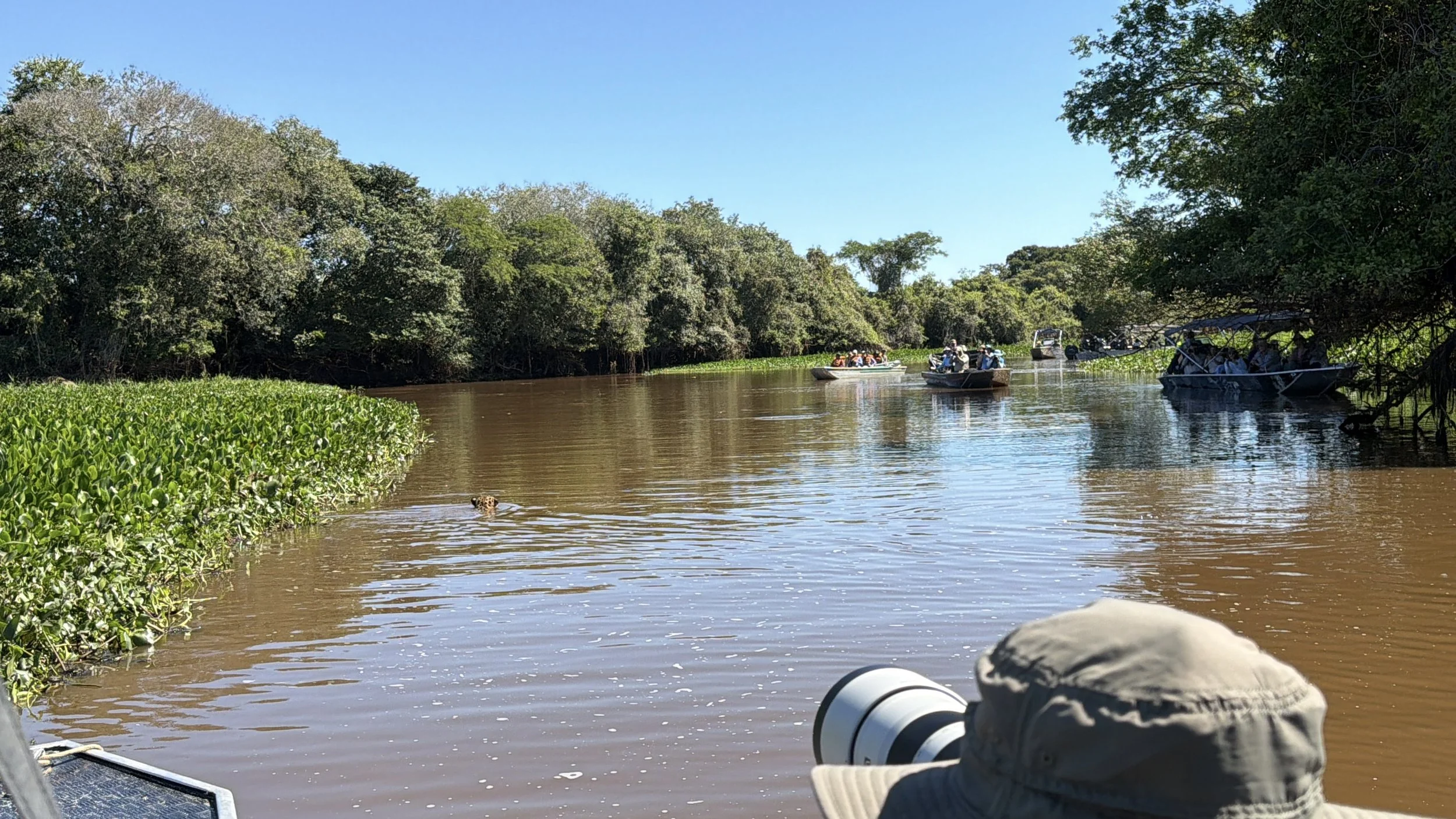
It was Osado, the diving cat. He is a large male we have come to know well.
As we watched him climb from the river, our captain suddenly spotted another jaguar walking through the forest.
Osado caught the scent almost immediately and disappeared into the trees to investigate.
The newcomer was Pantanero, a young three-year-old male.
The two briefly confronted one another before moving off together, Osado leading the way.
Pantanero eventually circled back and continued hunting along the shoreline while, across the river, another familiar cat appeared.
Medrosa.
She is Patricia's daughter and now eleven years old.
Following her turned out to be one of the best decisions of the day.
While moving along the riverbank she suddenly climbed into a tree, stopped, and surveyed her surroundings from above.
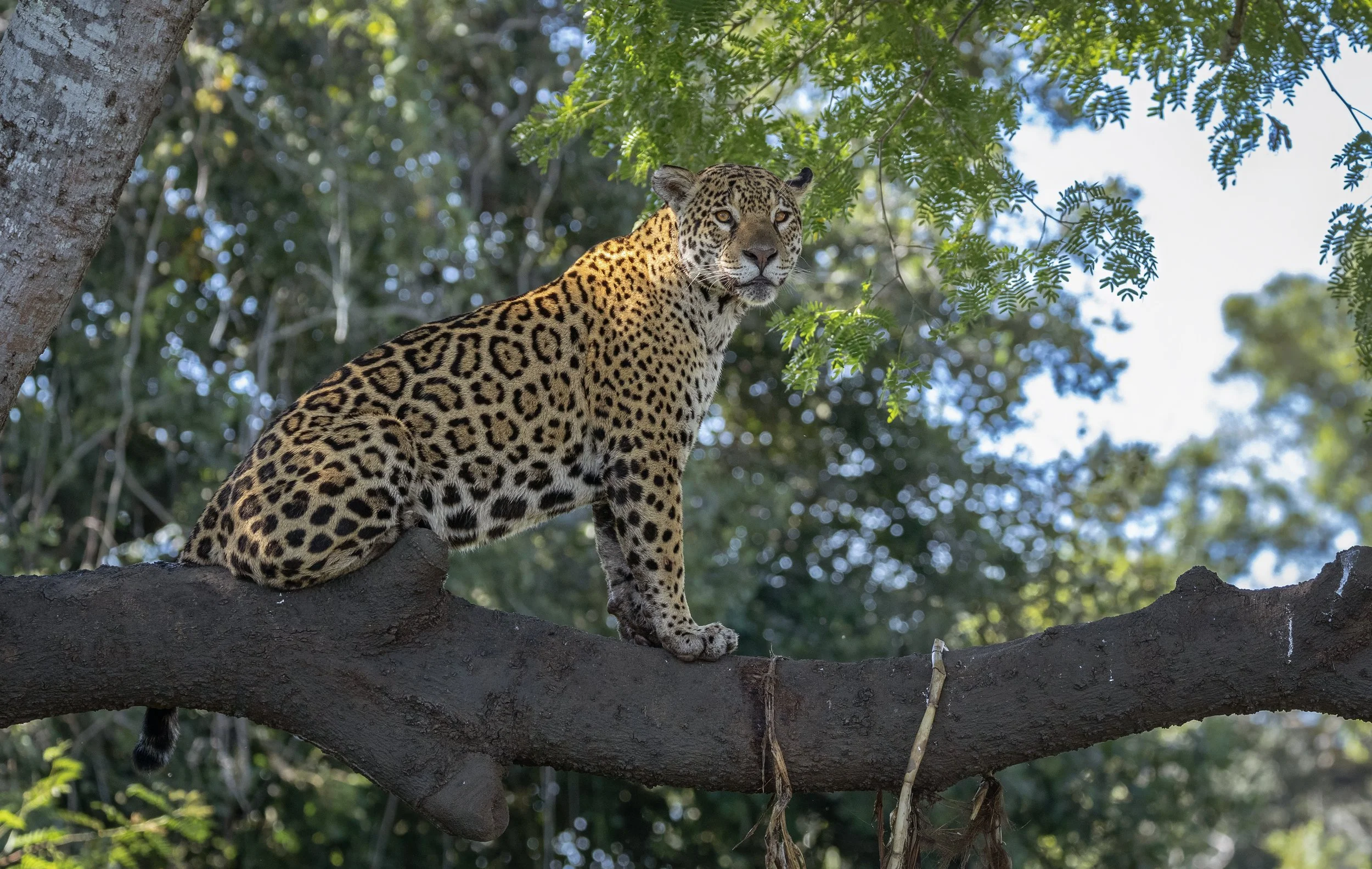
For several minutes she simply sat there, completely relaxed.
A wild jaguar, perched in a tree, framed perfectly by the forest.
It was one of those moments you never forget.
The afternoon continued delivering surprises.
Later we found Saseka, a four-year-old female who was abandoned as a cub and, as far as researchers know, is unrelated to the established river families. She reportedly has two cubs of her own this season.
Soon after, we encountered what appeared to be a mating pair.
Apeiara, a five-year-old daughter of Inca, was with a male named Oriel, a cat researchers still know relatively little about.
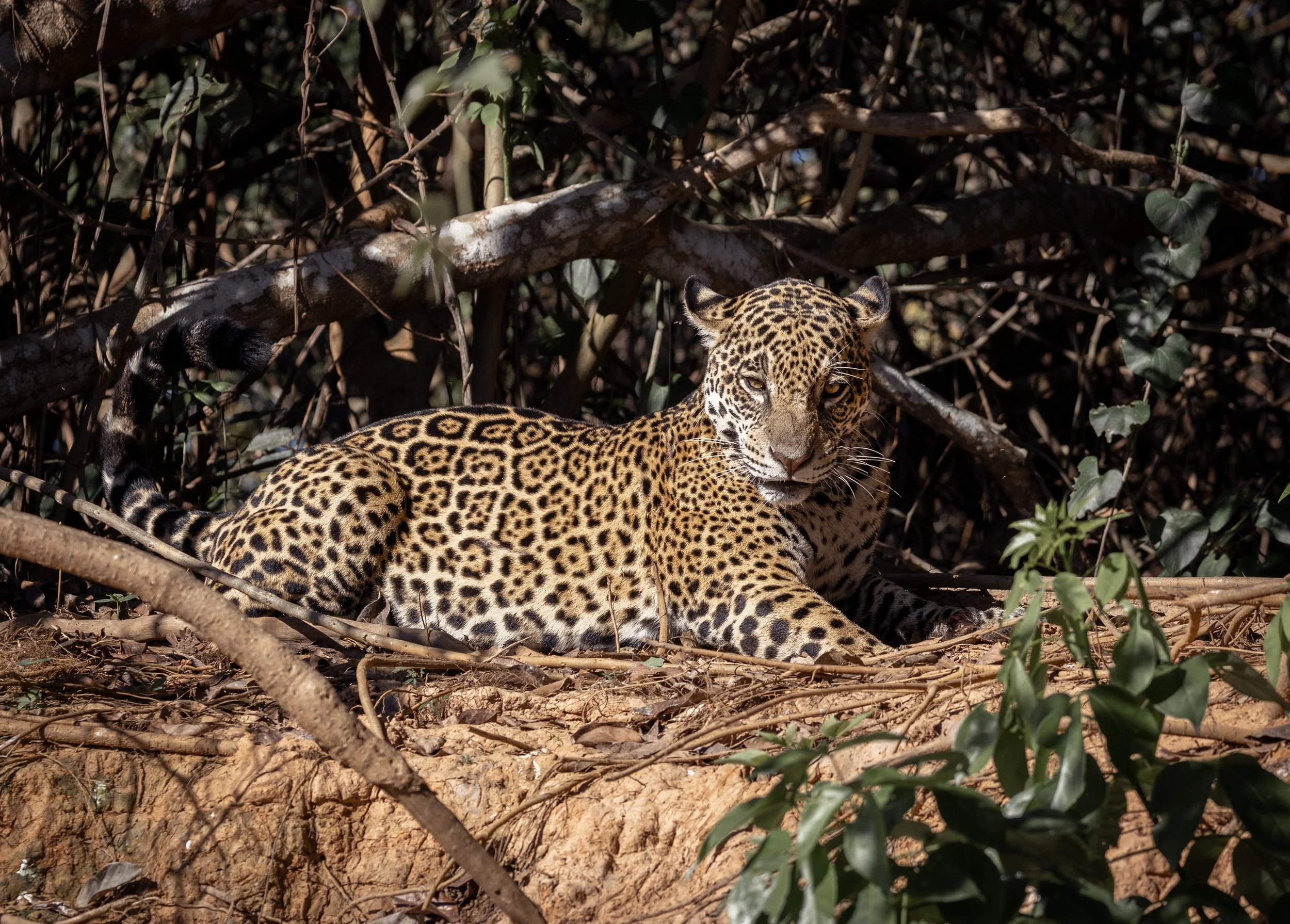
Apeiara
By the end of the day we had seen eight different jaguars.
It was, without question, a cat day.
Our wildlife wasn't finished yet.
That afternoon we drove to an ocelot photography blind.
I've wanted to visit this place for years.
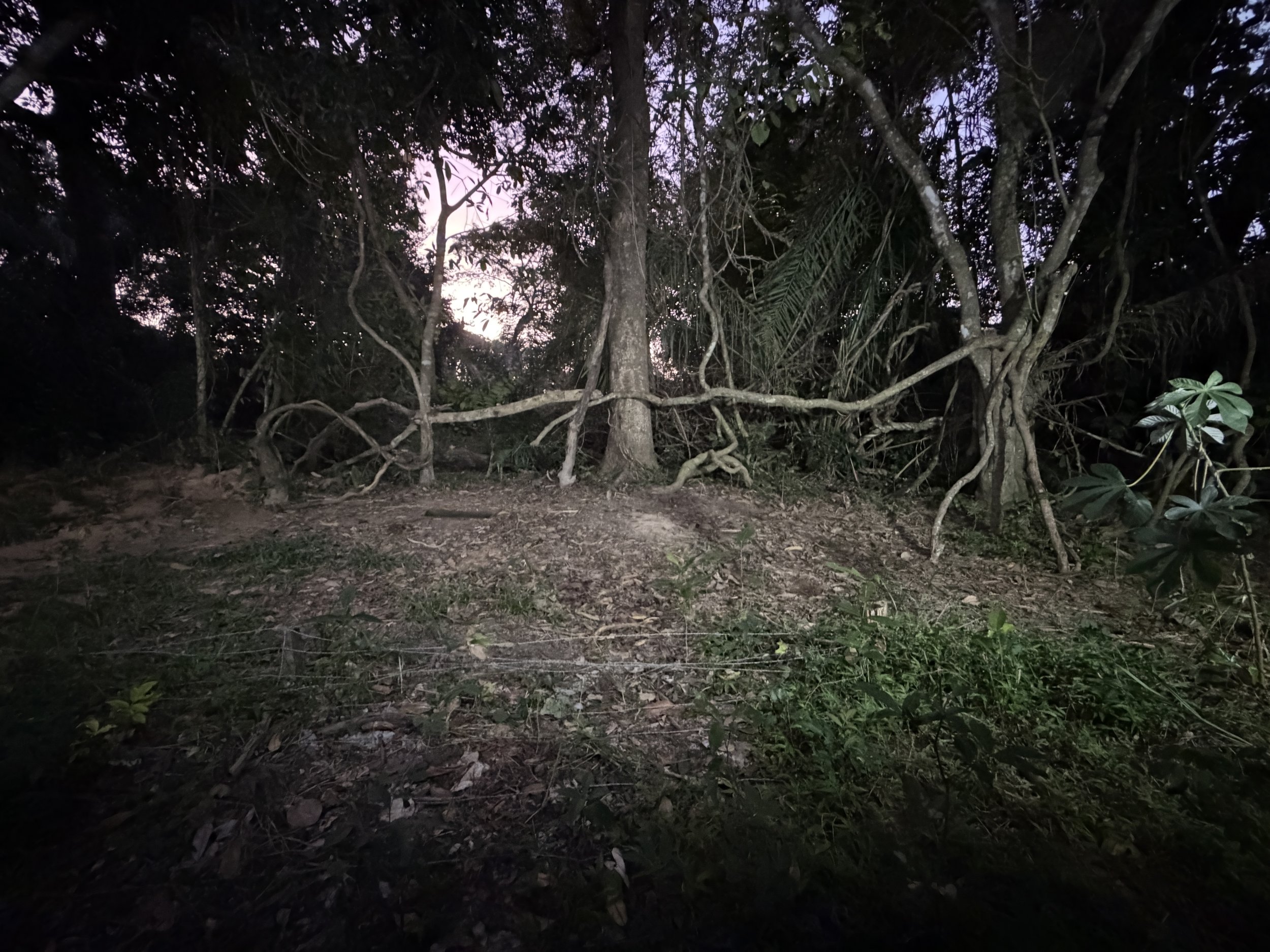
The operators boldly advertise a 100% guaranteed ocelot encounter.
That is a very confident statement when you're talking about a wild animal.
They place small pieces of chicken near the blind to encourage the cat to visit.
I'll admit I have mixed feelings.
The wildlife photographer in me loves the opportunity to photograph one of South America's most elusive cats.
The conservationist in me naturally asks questions.
Then again, I've spent years supporting organized shark-feeding operations because they create economic value for living animals while allowing people to connect with predators they would otherwise fear.
Here, the ocelot remains completely wild. The cat chooses whether it comes or not, and it leaves whenever it wants.
So I wanted to experience it for myself before forming an opinion.
We settled into the blind.
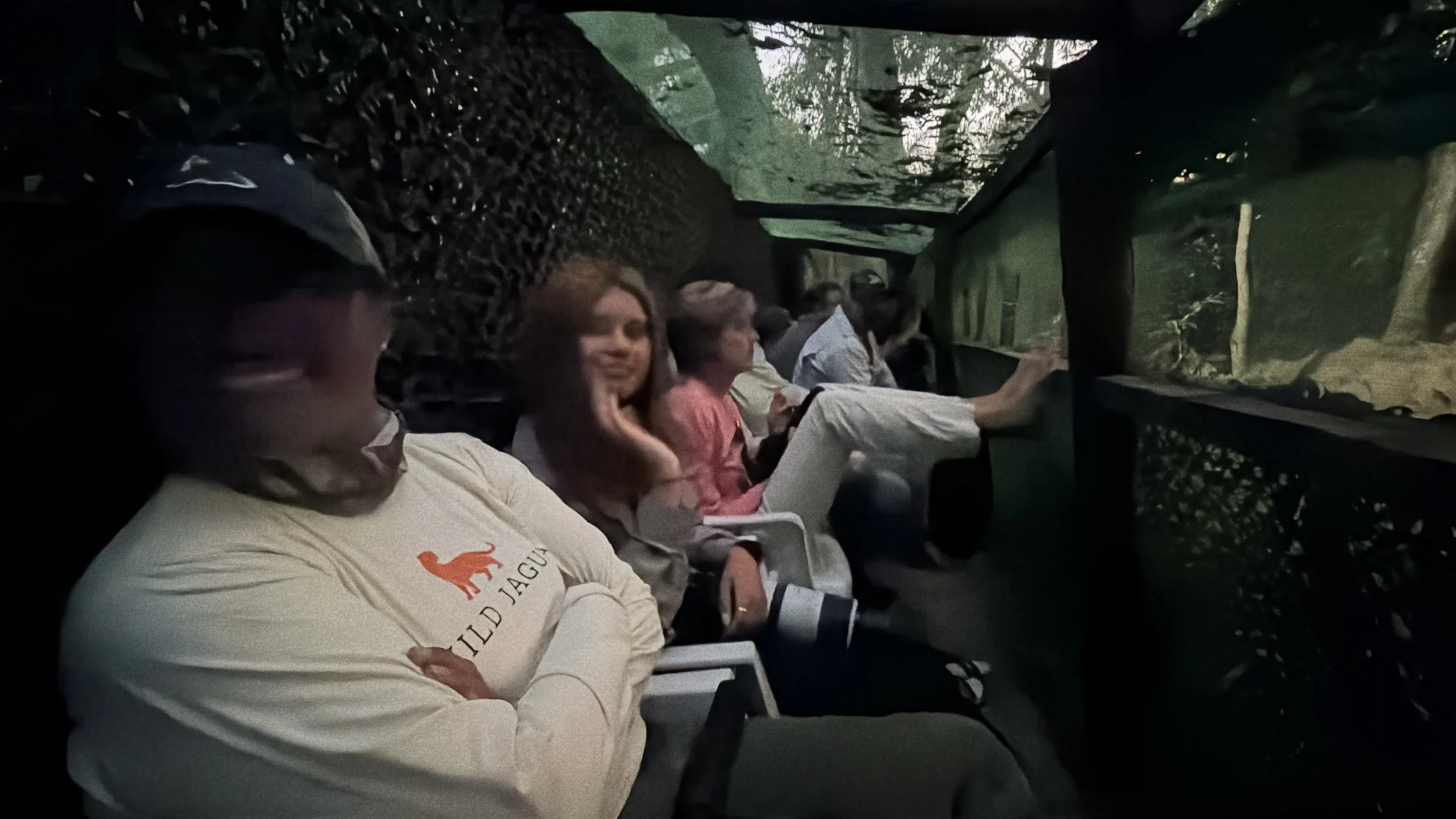
And waited.
And waited.
And waited.
Two hours later we quietly packed our cameras and walked back out.
No ocelot.
No photographs.
So much for the 100% guarantee.
Sometimes nature likes reminding us that she doesn't read the advertising.
July 15, 2026. Day Four
Wildlife Seen Today
Yellow anaconda
Caracara feeding on a giant ameiva lizard
Troop of howler monkeys
Jaguar hunting caiman (Carvarinha)
Two tapirs
Maned wolf
Ocelot
White-lipped peccary
Family of capybaras
Today was a little different.
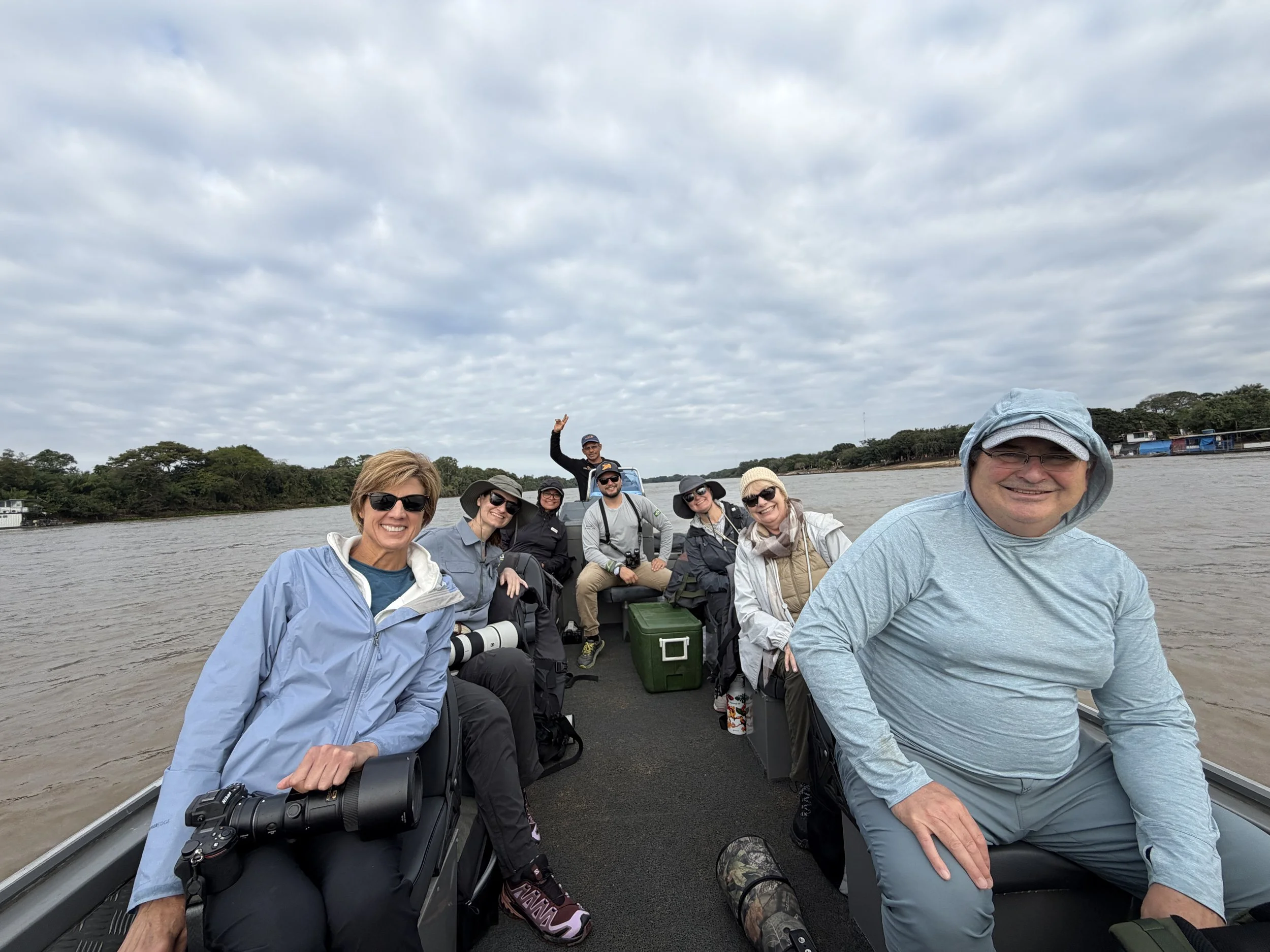
We packed an overnight bag before leaving the lodge because, around midday, we would make the long journey by boat to the maned wolf camp.
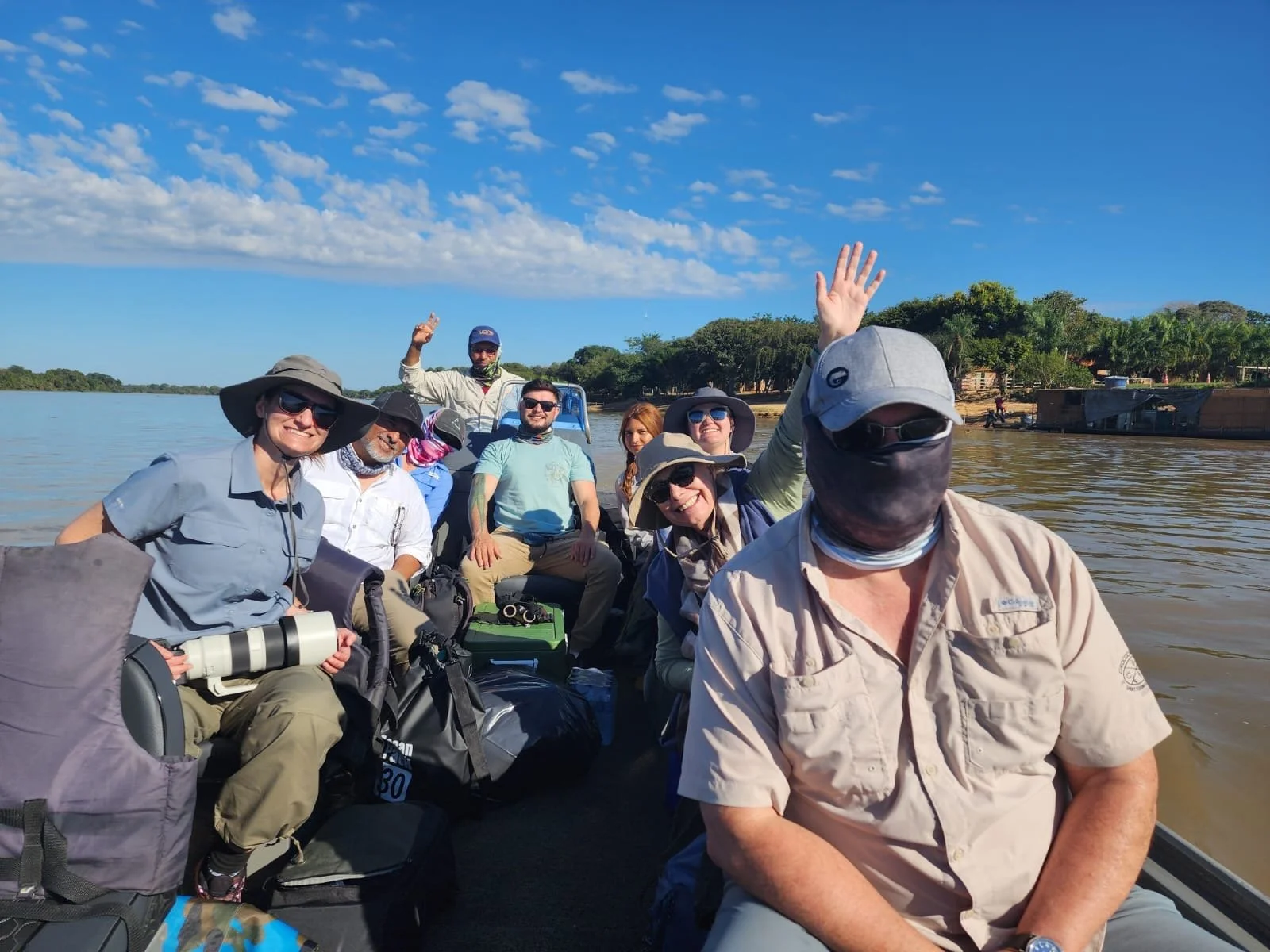
Thank you Joyce for this photo.
The plan was simple.
Spend the morning searching for jaguars, then leave the river behind and trade one predator for another… maned wolves!
Our first stop produced a beautiful surprise.
Coiled in the vegetation was a bright yellow male anaconda. Unfortunately, he had chosen one of the least photogenic places imaginable to spend the morning, but simply seeing him was enough. His bright yellow coloration made him one of the prettiest anacondas I've encountered.
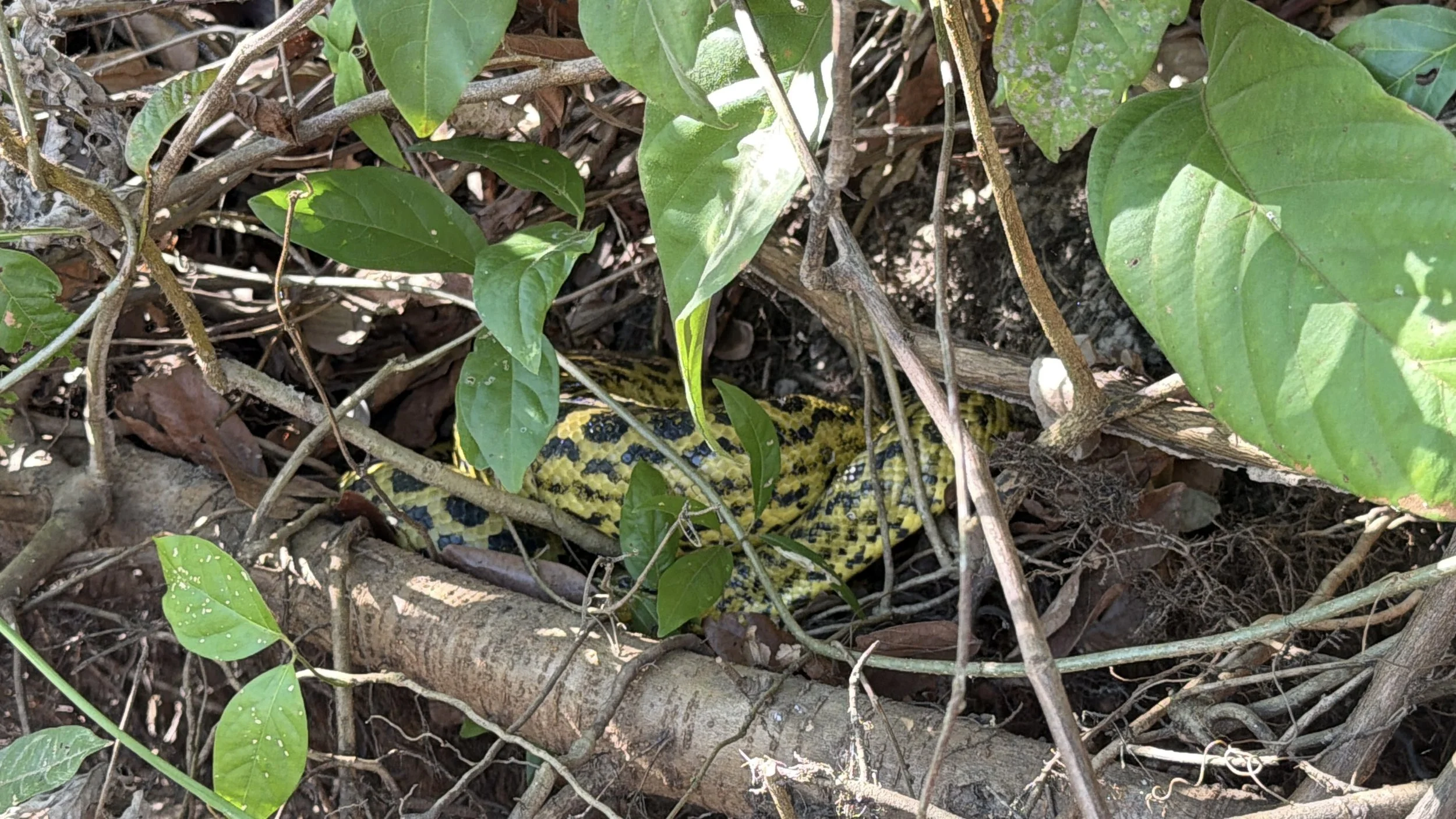
Further down the river we found several boats gathered around a hunting jaguar. By the time we arrived, however, the cat had already slipped into the forest and disappeared.
Nature doesn't wait for anyone.
Not long afterward we stopped to photograph a family of capybaras resting beneath the shade of a tree. Standing nearby was a caracara enjoying a freshly killed giant ameiva lizard.
The bright blues and greens of the lizard contrasted beautifully against the earthy colors of the Pantanal.
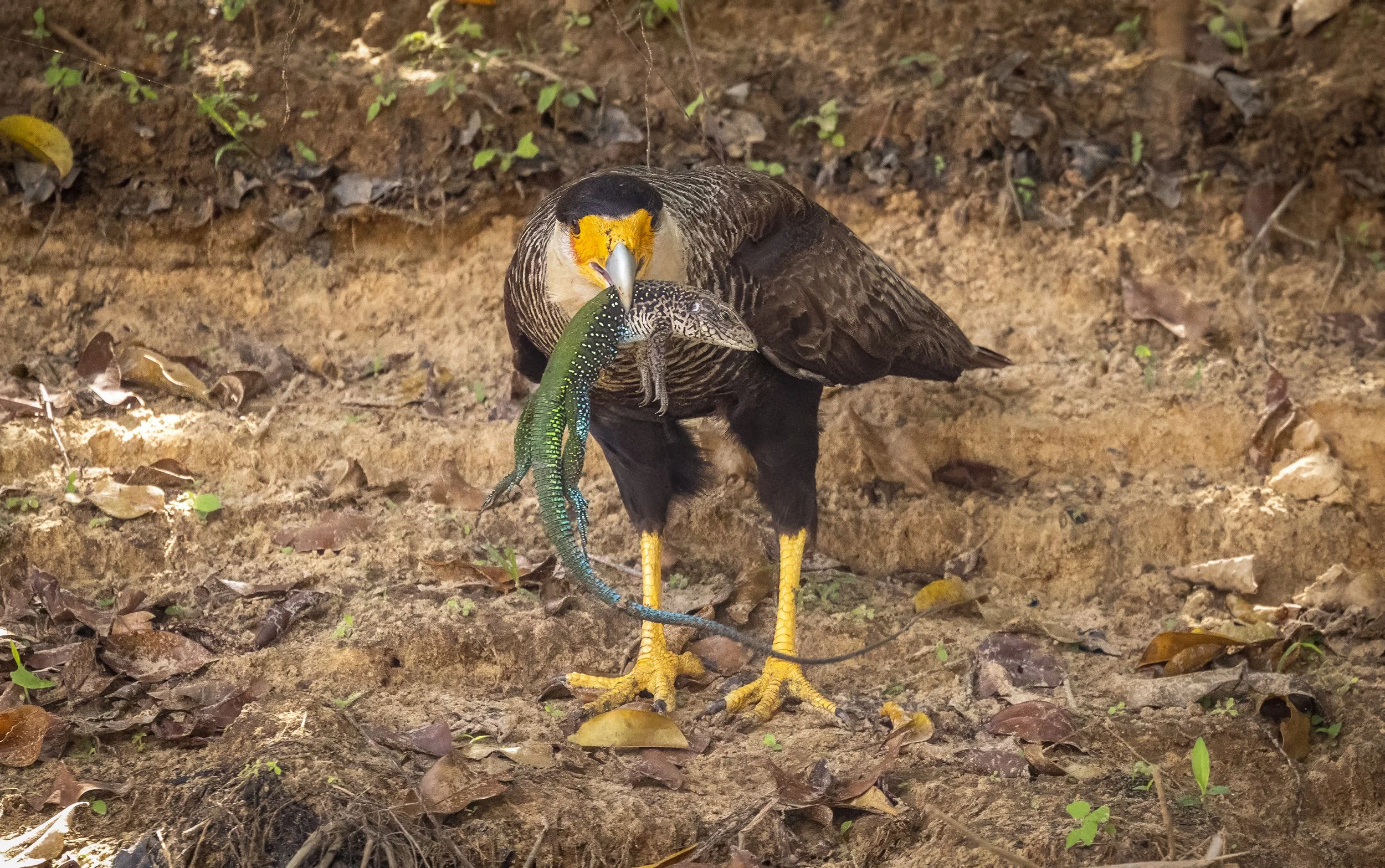
A little later we found a large troop of howler monkeys spread through an excellent viewing tree, giving everyone plenty of opportunities for photographs.
It was a huge family, hanging out lazily in the trees. There were a lot of males in this troop. I found that interesting. Males are usually very protective of their females.
In this species of howler monkeys, the males are black and females are an orange / brown color.
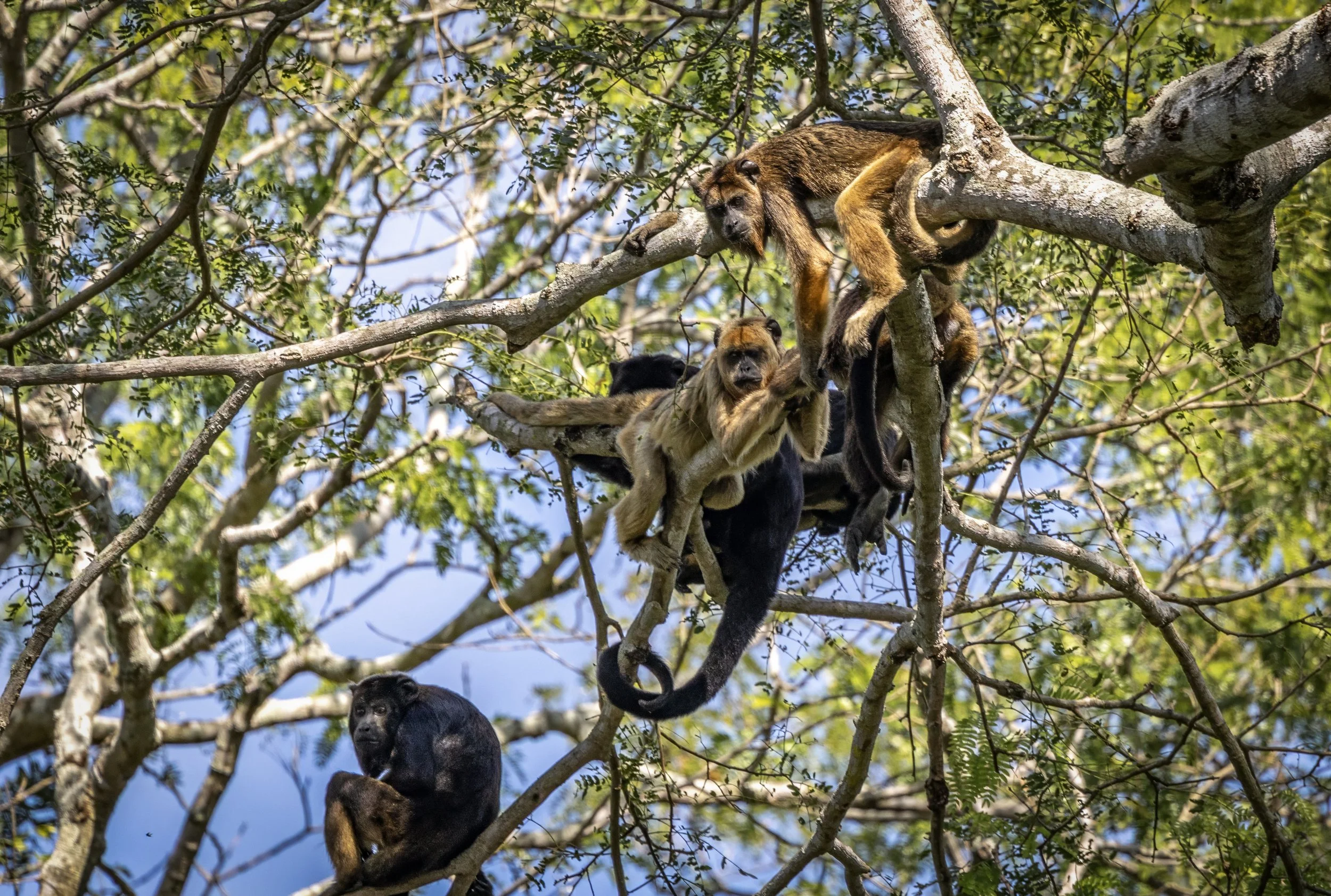
At 11:20 we finally turned toward the wolf camp.
As we motored along the river, our captain suddenly noticed splashing near the shoreline.
It was a jaguar and she was wrestling with something in the water.
By the time we reached the scene, the caiman was fighting for it’s life.
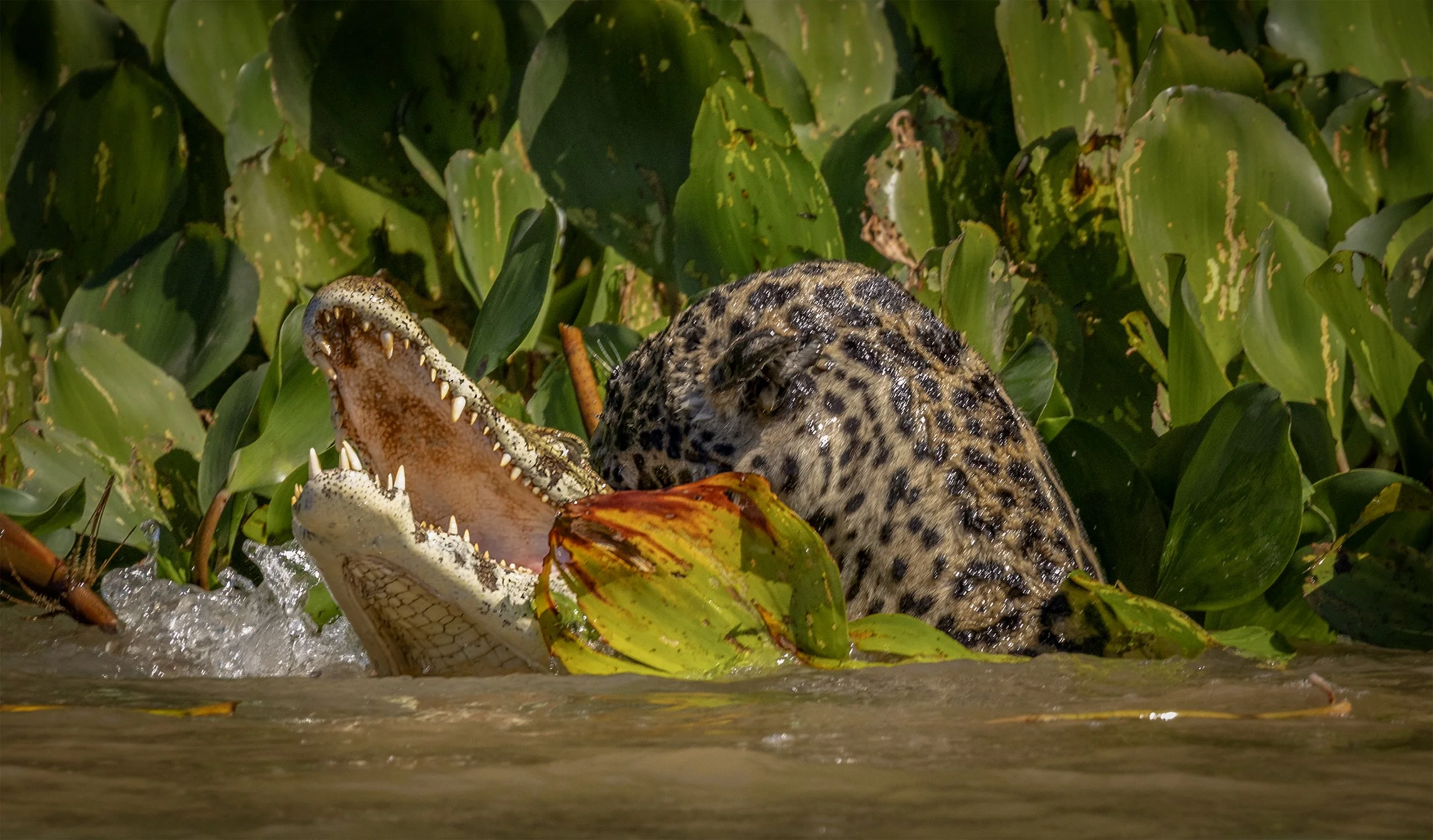
A ten-year-old female named Carvarinha had caught the caiman and was desperatly trying to kill the large animal.
For a few frantic seconds they battled in the river before the caiman somehow managed to escape.
The entire encounter happened so quickly that all we managed were a handful of proof-of-life photographs.
Still, witnessing a wild jaguar actively hunting was unforgettable.
Even better, we had the encounter entirely to ourselves.
No other boats.
Just us.
Carvarinha's parents are unknown to researchers, but she has raised three litters during her lifetime. One of the fathers of her cubs was Osado, our diving cat.
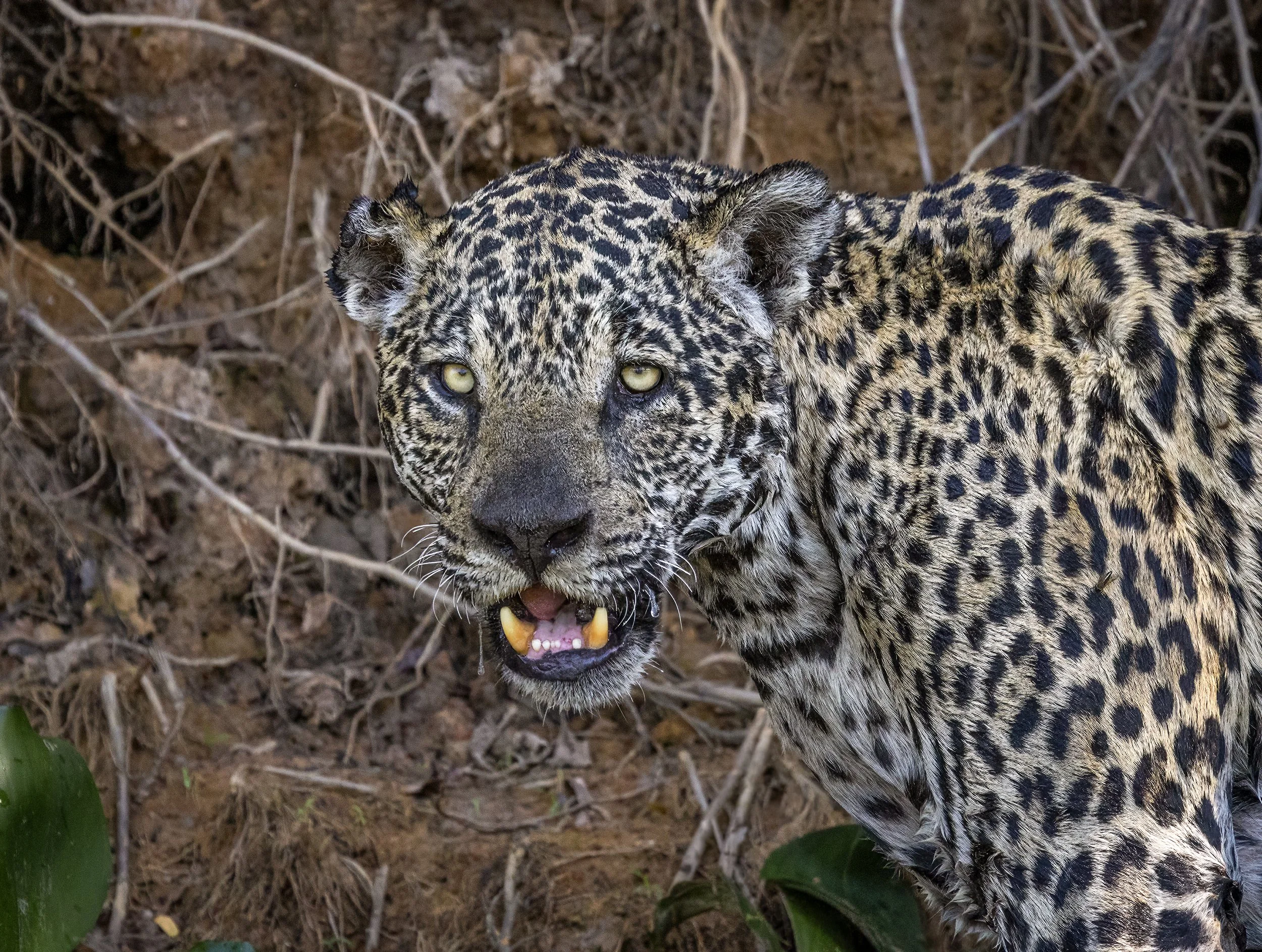
Carvarinha exhausted after her efforts to catch the caiman.
3PM. We arrived at the wolf lodge.
The property was already alive with wildlife.
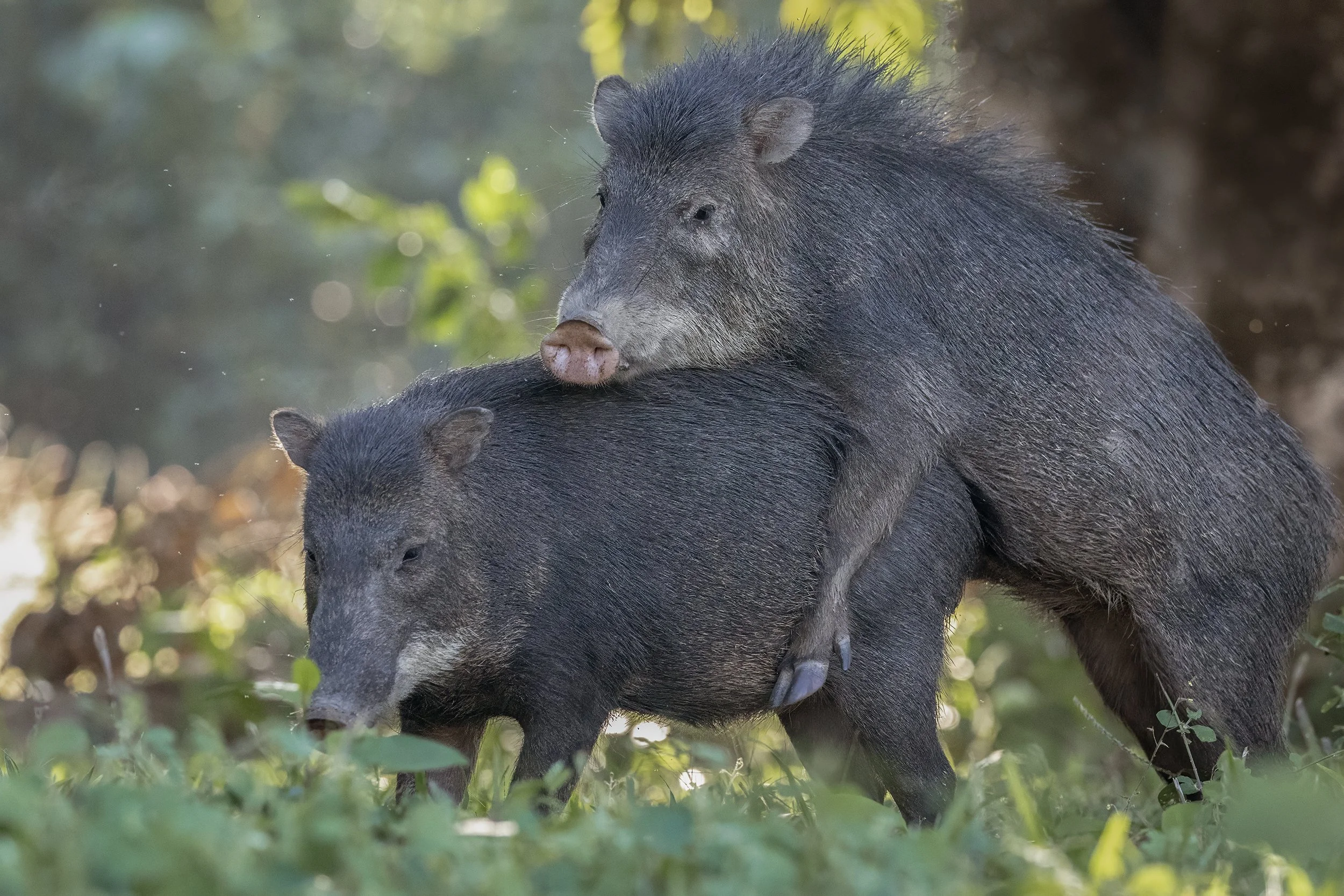
A family of capybaras grazed peacefully across the open grass while a large herd of white-lipped peccaries wandered onto the grounds.
A pair of peccaries were mating away from the main herd.
As the afternoon slowly turned into evening, anticipation continued building.
We were hoping the maned wolf was going to arrive before sunset, but it did not.
After being completely skunked at the ocelot blind the previous evening, everyone's confidence had slipped just a little.
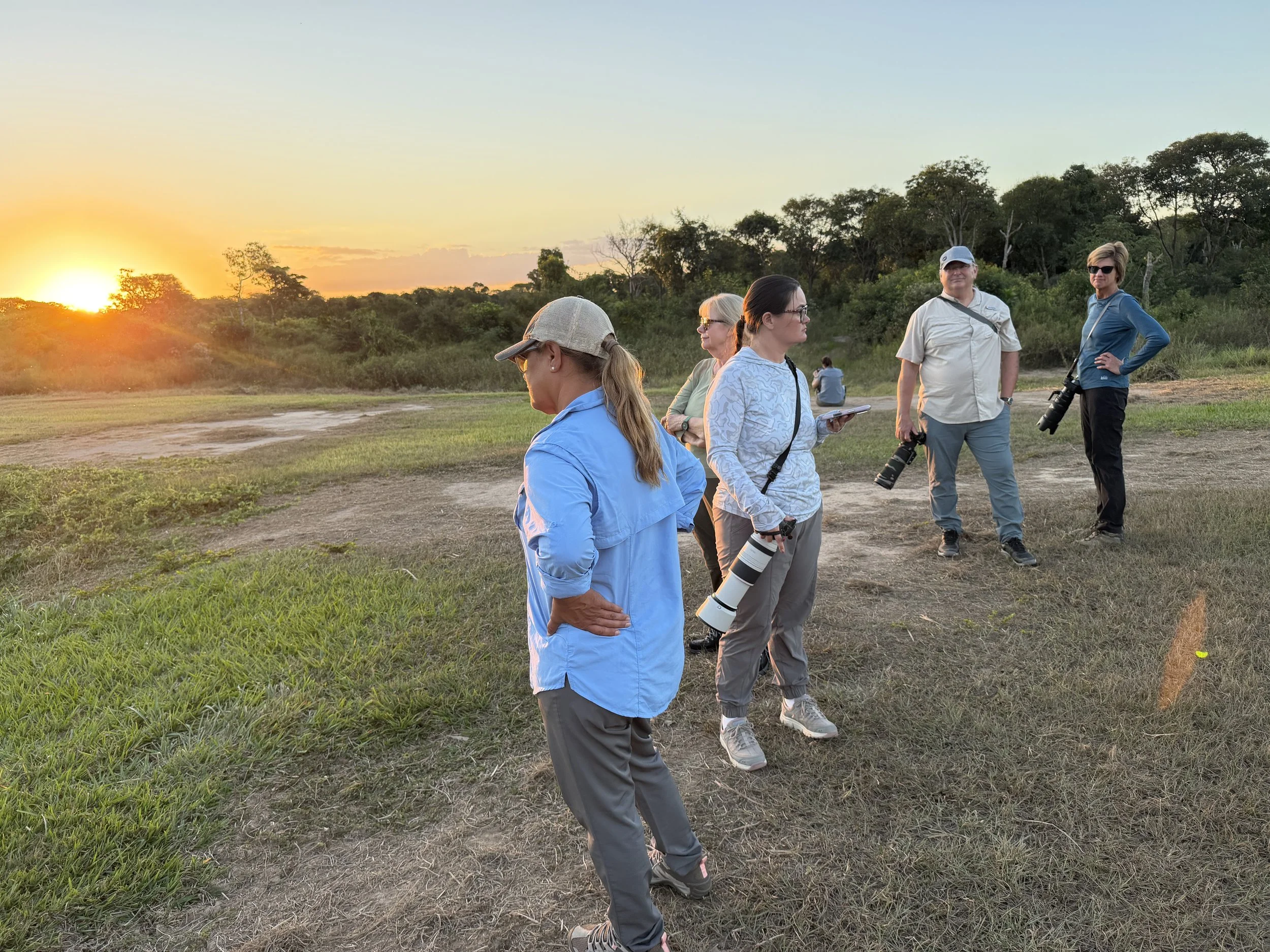
I kept telling the group not to worry.
Our host added another surprise.
For the past week, an ocelot had also been visiting the property every evening.
Now… I was trying not to get my hopes up too much.
At six o'clock our host placed a few small pieces of meat out near the edge of the clearing and instructed us to quietly take our seats.
No photography blind.
No barriers.
Just sit still, remain patient, and let nature decide.
Six-thirty came.
Nothing.
Another thirty minutes passed.
Still nothing.
We were preparing to head inside for dinner when the darkness suddenly came alive.
A massive tapir emerged from the shadows, snorting softly as it searched for food.
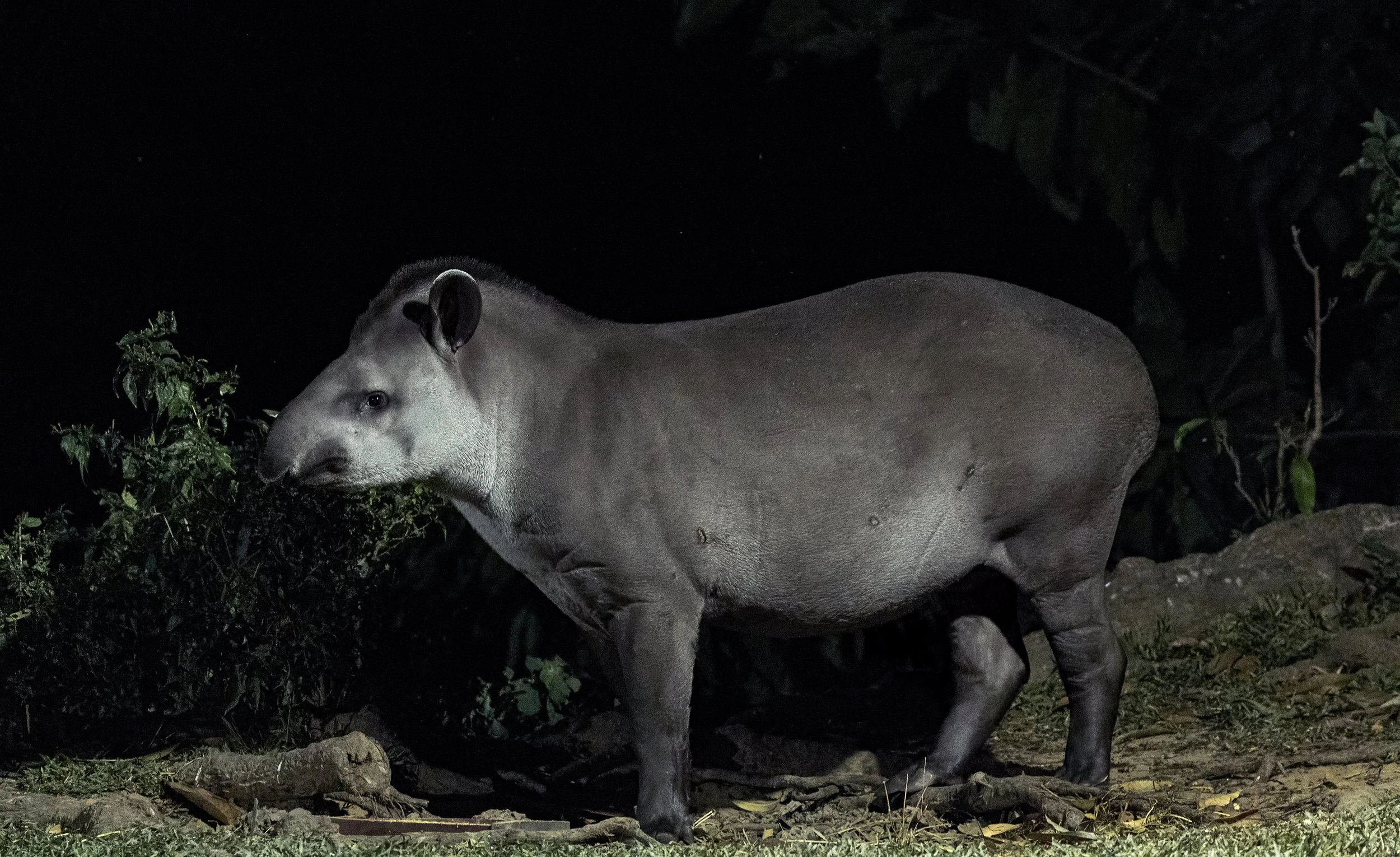
Cameras immediately erupted.
Then, while everyone was focused on the tapir, I glanced to my left.
A maned wolf.
It walked calmly into the clearing as if it owned the place.
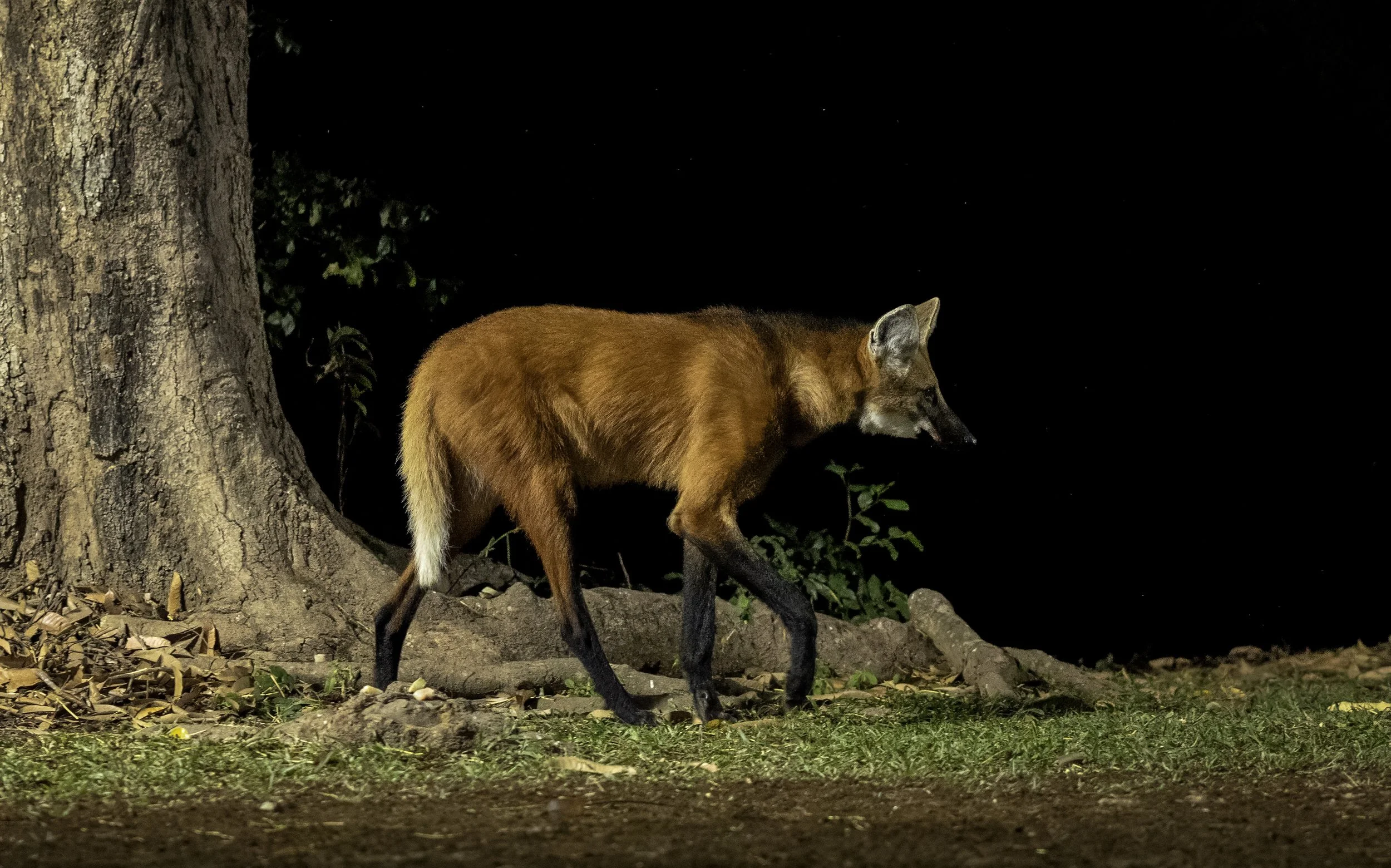
The tapir spotted it and immediately disappeared into the darkness while we spent the next thirty minutes photographing one of South America's most elegant predators.
When the wolf finally slipped back into the night, everyone was grinning.
High fives all around.
What an incredible encounter.
We headed inside for dinner believing the evening couldn't possibly get any better.
Twenty minutes later our host quietly entered the dining room with a flashlight.
"The cat is here."
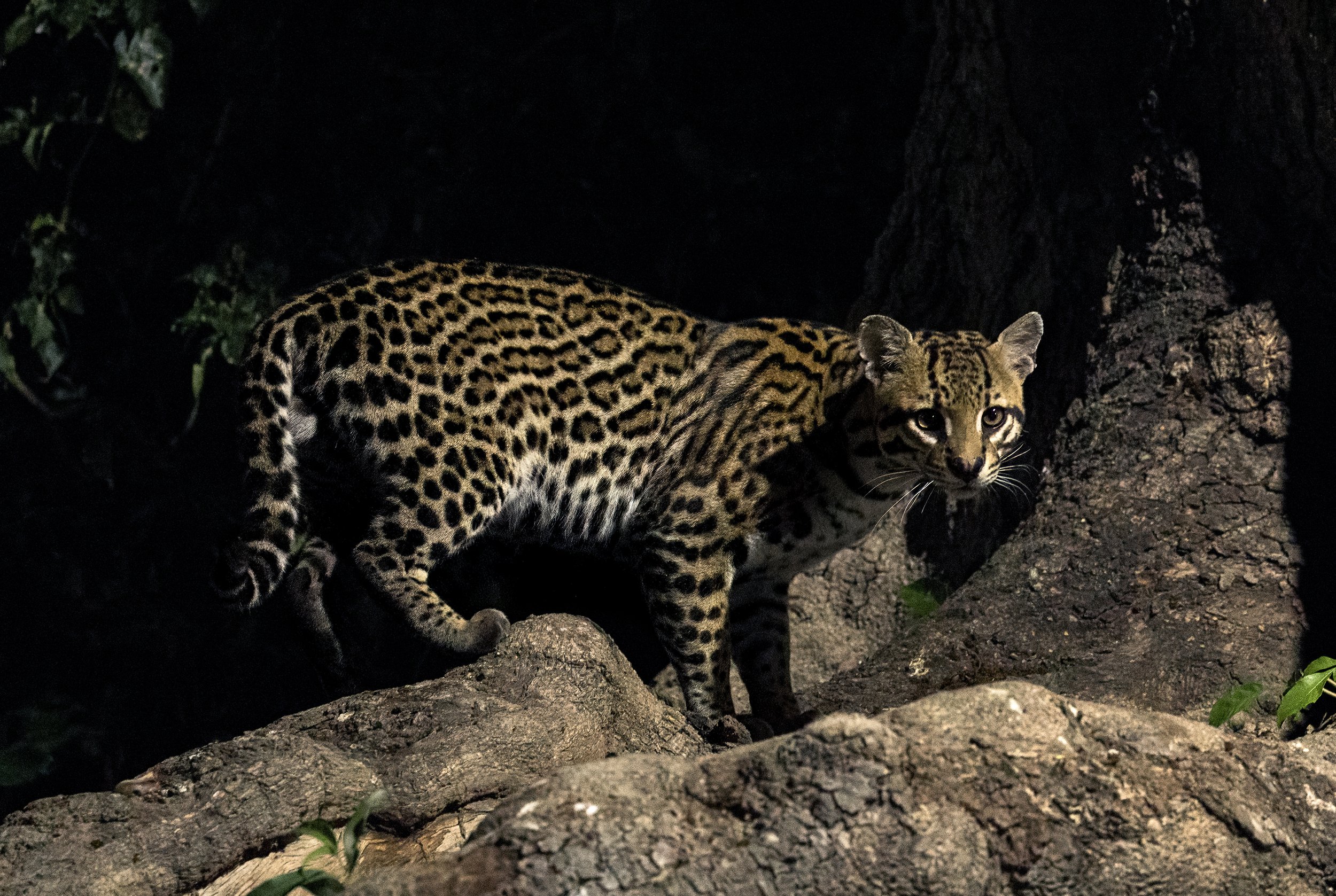
We grabbed our cameras and hurried back outside.
While we waited, another tapir appeared.
Then, from deep within the shadows, one of the most beautiful wild cats I've ever seen cautiously stepped into the light.
The ocelot.
Every camera began silently firing.
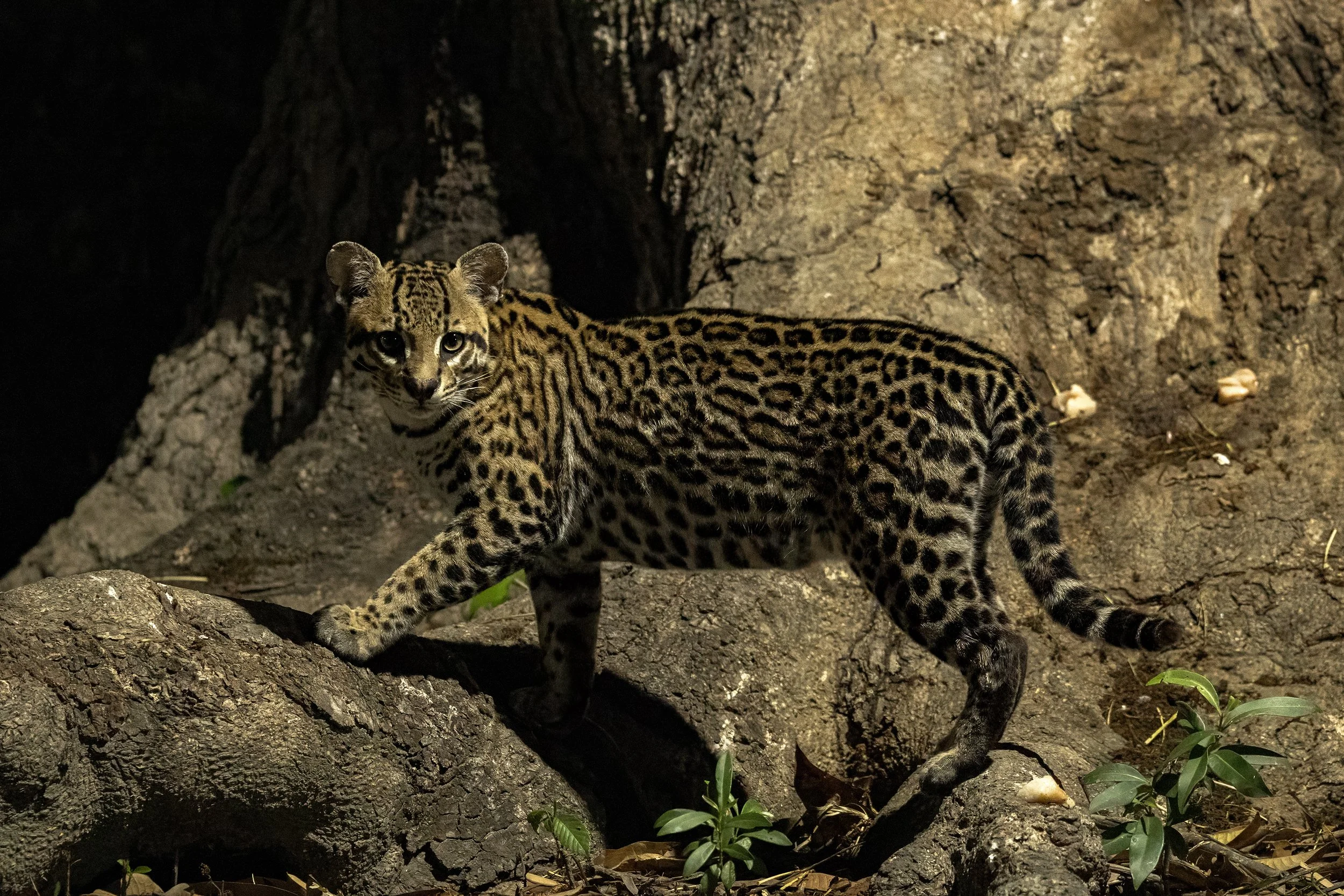
The cat remained understandably cautious, constantly scanning its surroundings, but stayed long enough for everyone to enjoy one of the rarest wildlife encounters of the trip.
It eventually disappeared into the darkness...
...only to return again.
And then once more.
Several of us stayed out late simply enjoying every second.
Photographing a wild ocelot had been a dream of mine for years.
Tonight, that dream finally became reality.
What a way to finish an unforgettable day in the Pantanal.
Just… wow, wow wow.
July 16, 2026. Day Five.
Wildlife Seen Today
✔ Red-throated piping guan
✔ Orange-winged Amazon parrot
✔ Chestnut-eared aracari
✔ Four jaguars: Pantanero, Saseka, Rafa, and Tomas
✔ South American rattlesnake
✔ Giant river otters
✔ Water buffalo
Our Final Day
At 8:25 a.m., we began the long ride back toward Porto Jofre for our final day on the river.
We had all been up early exploring the lodge property, hoping the maned wolf might return, but it never showed.
Instead, we entertained ourselves photographing the birds scattered around the lodge… parrots, parakeets, and several other colorful species.
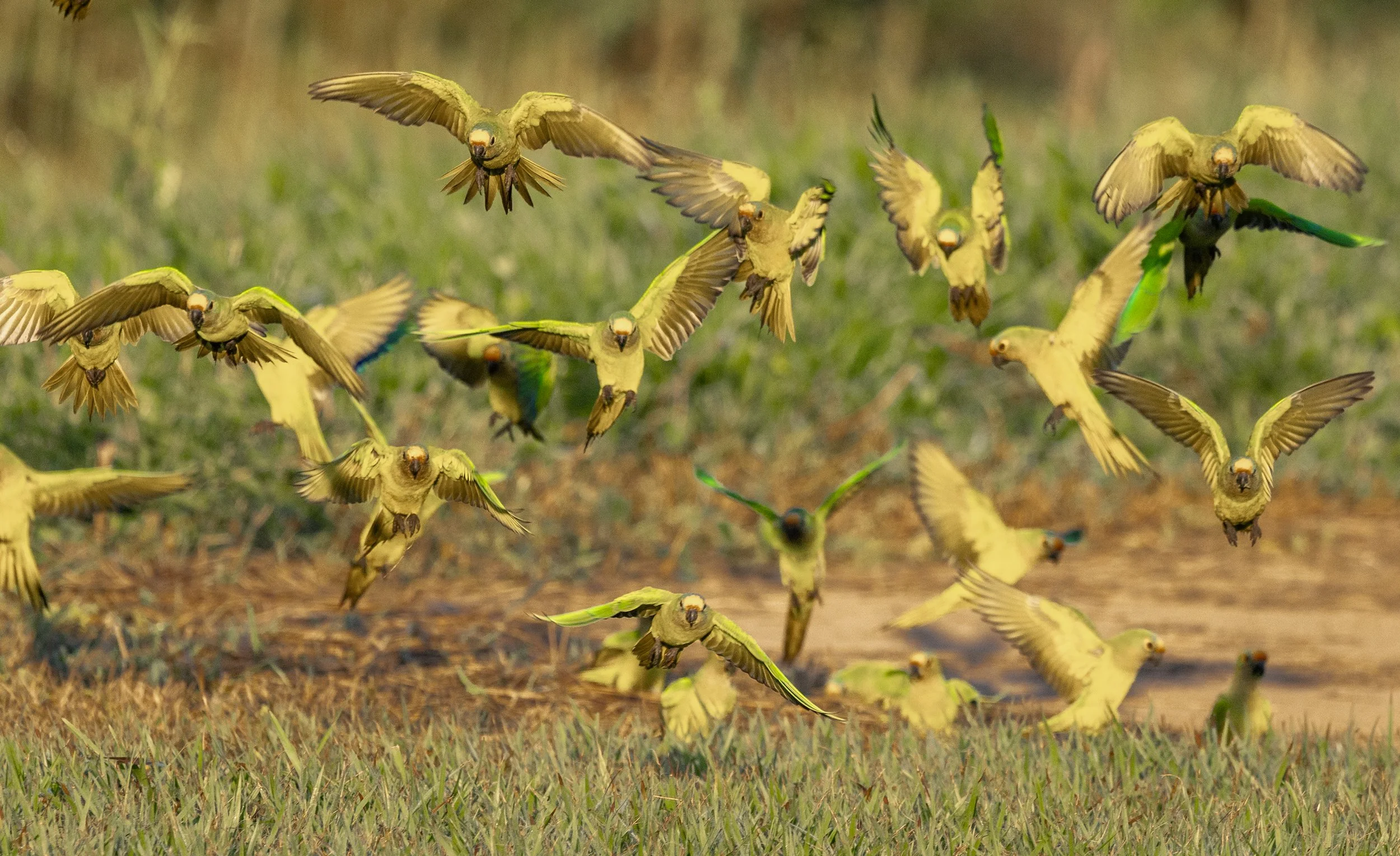
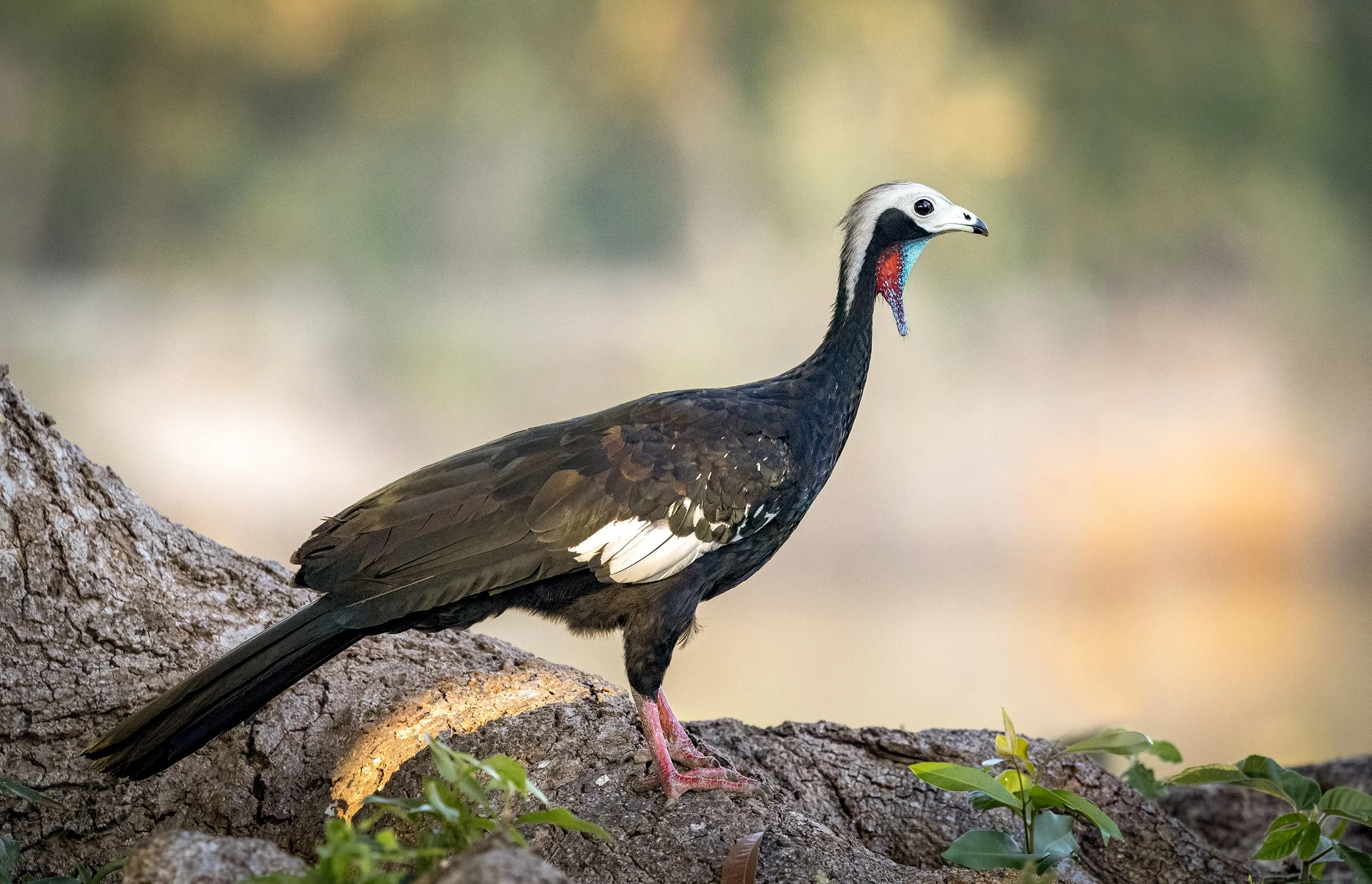
I was especially excited to photograph a red-throated piping guan.
What an absolutely beautiful bird.
A few days earlier, at the ocelot blind, I had seen a blue-throated piping guan, but only managed a proof-of-life photograph. I had only recently learned about these birds and discovered that both the red-throated and blue-throated varieties can be found here in the Pantanal.
Such a cool species.
Then we loaded the boat and set off in search of more hunting jaguars and, hopefully, a large family of giant river otters.
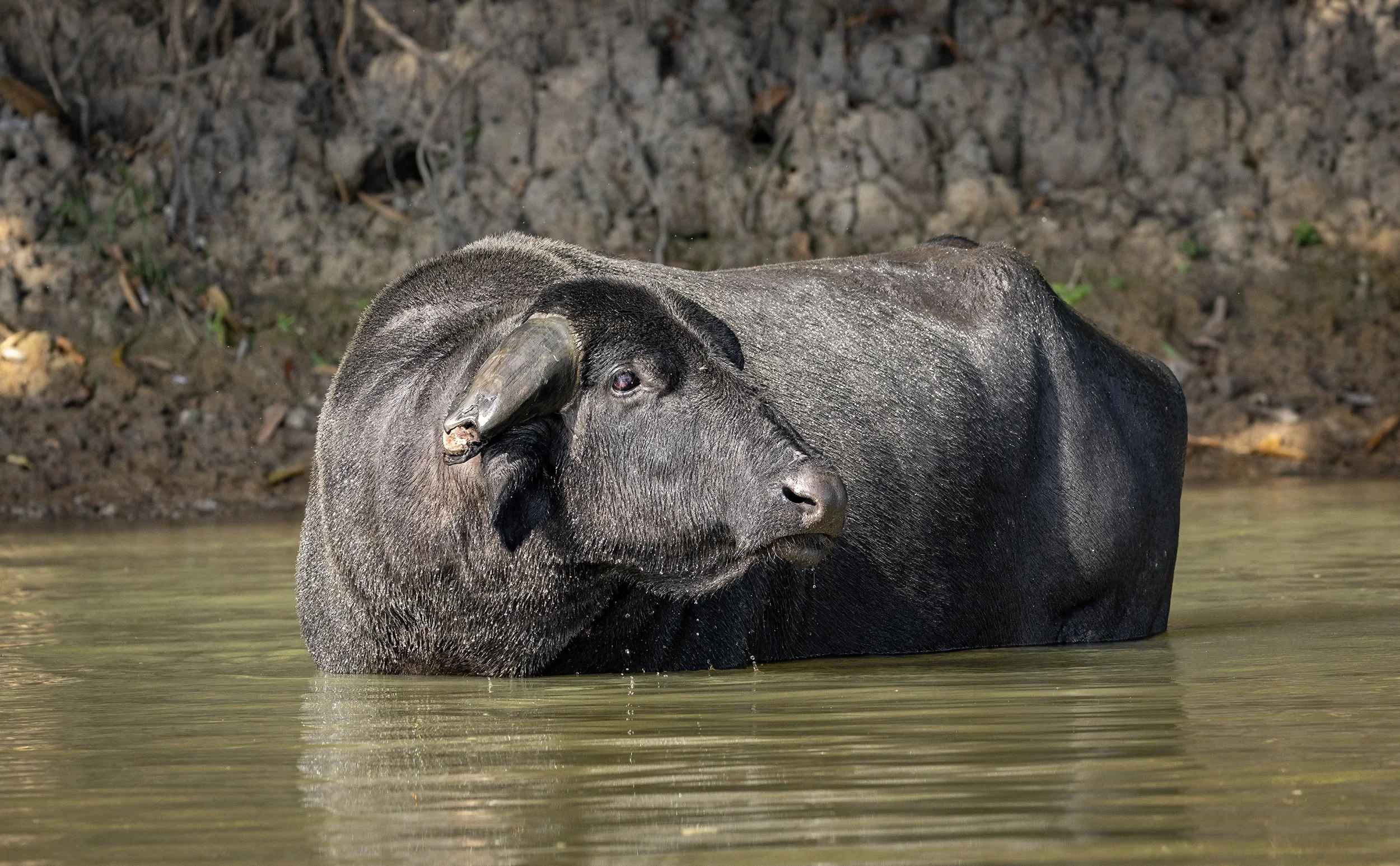
Along the way, we found a massive water buffalo lying in the river to cool off.
He was not happy that we stopped to photograph him.
He thrashed around, stood up, and stared us down.
One of his horns had recently broken off. My guess is that he had been in a serious fight with another bull. There were no females around him, so perhaps he had also lost his breeding privileges.
That might explain why he seemed so angry with the world.
We got the message and moved on.
The moment we left, he settled back into the water.
Farther downriver, we found a family of giant river otters sleeping along the bank. We photographed them for a while, hoping they might wake up and begin hunting, but they appeared completely committed to their nap.
So we left them in peace.
Not long afterward, Tom spotted what looked like a strange stick floating on the surface of the river.
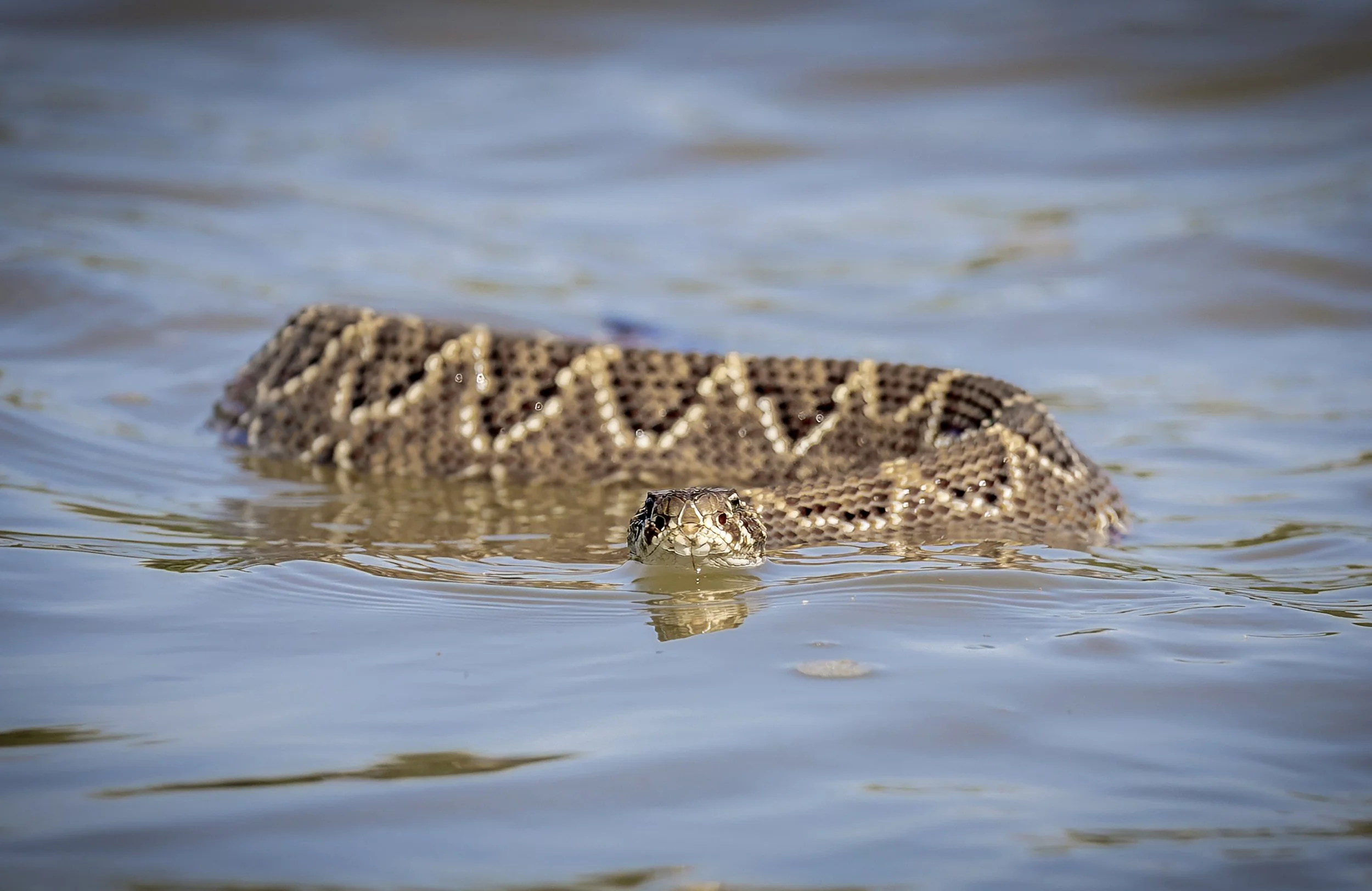
It turned out to be a South American rattlesnake swimming across.
This was an incredibly rare find for the Pantanal.
We followed and photographed the snake as it crossed the river and safely disappeared into the vegetation on the opposite bank.
What a cool encounter.
Once we returned to the area where the jaguars had been most active, it did not take long to find our first cat.
Pantanero was hunting along the river.
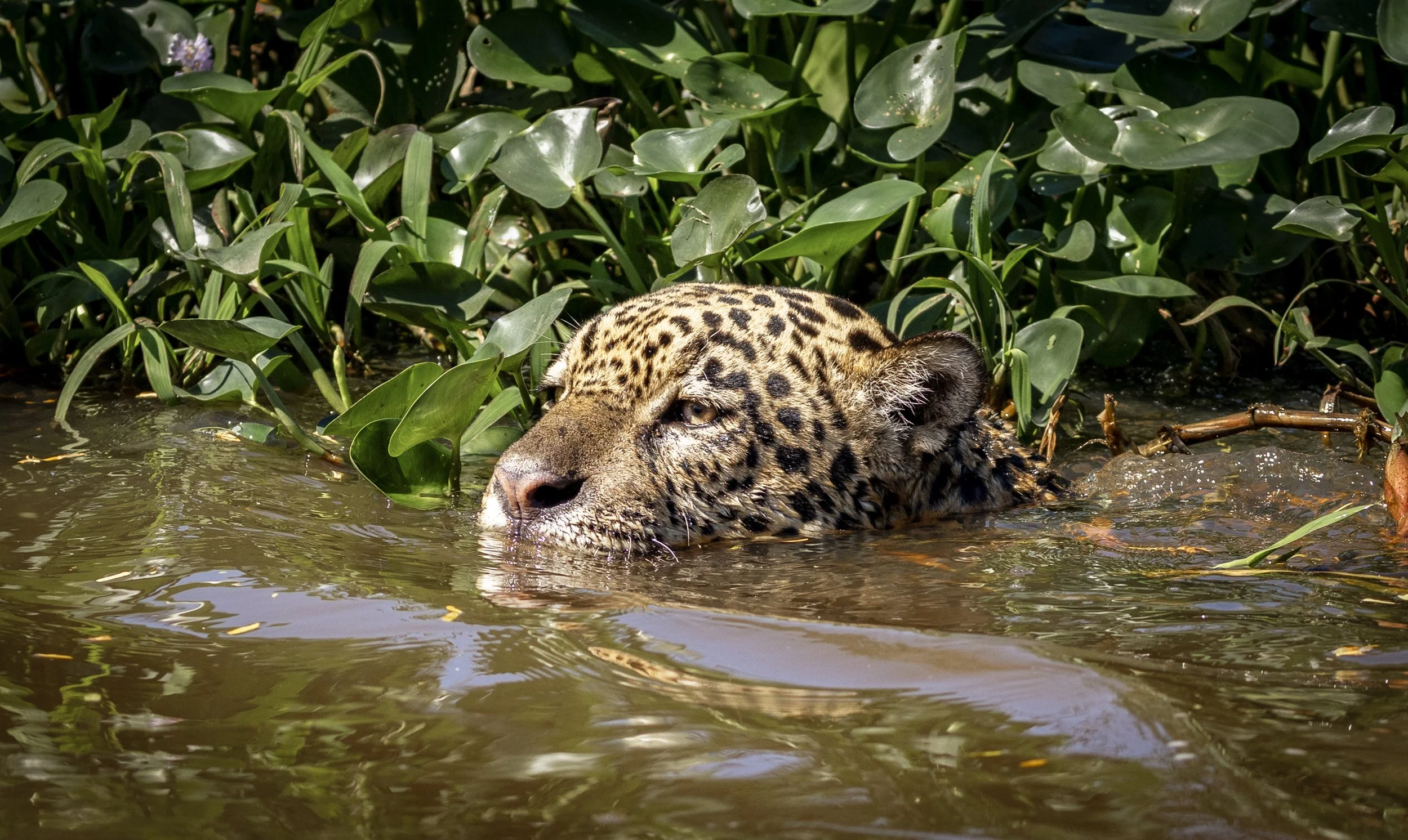
Pantanero, is still refining his hunting skills and has a lot to learn.
We photographed him for a short while before he slipped into the brush.
Later, we found him again and followed as he made several clumsy hunting attempts along the shoreline. Sadly, he came up empty and eventually retreated into the forest.
The day was becoming extremely hot.
While we were having lunch, we noticed another boat photographing something deep in the vegetation.
It turned out to be a sleeping jaguar.
Saseka.
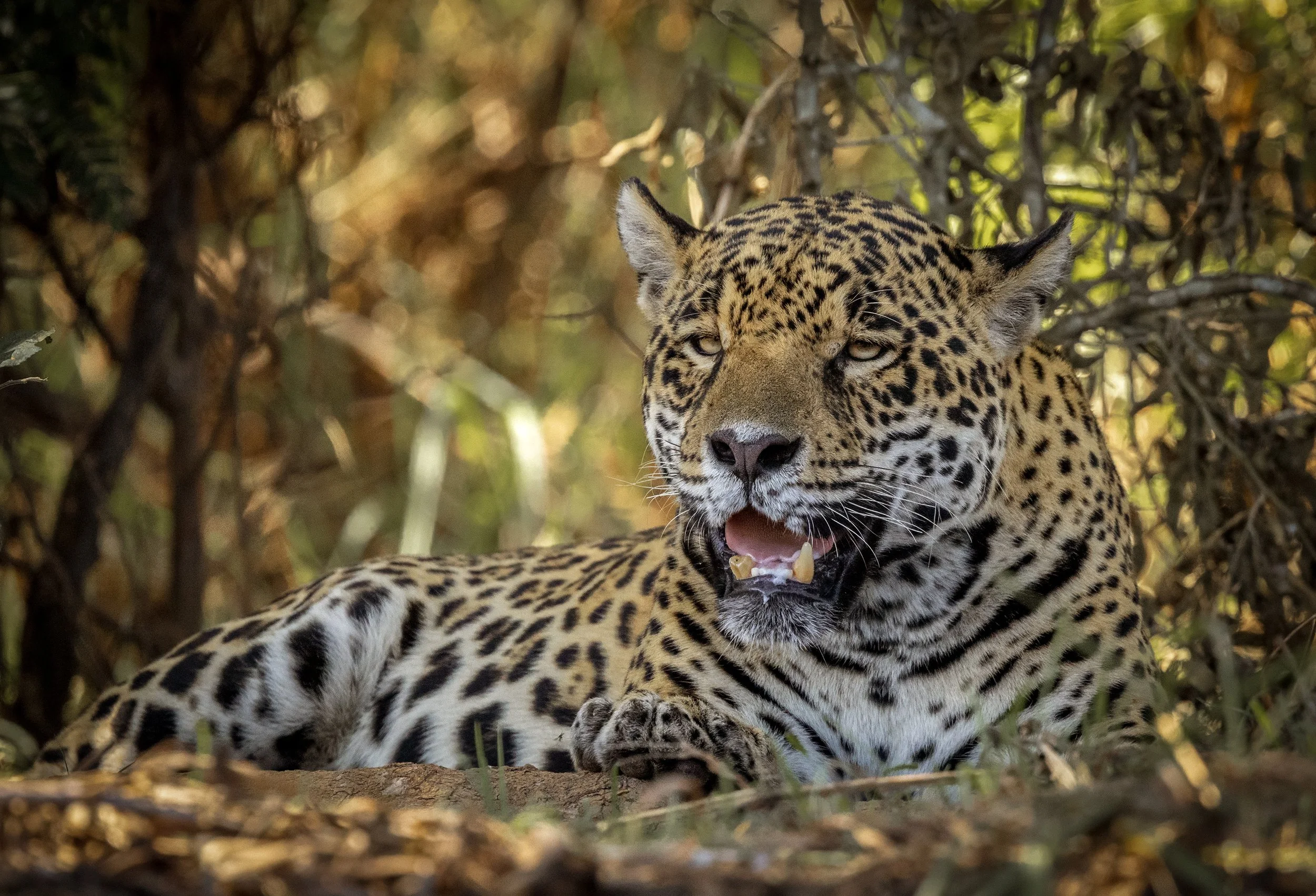
Saseka hiding froim the heat.
She is five years old and the daughter of Overa, a cat we have not yet met. Saseka is reported to have two young cubs, although no one has managed to get a good photograph of them yet.
Then, in the middle of all this, our daughter Sophia had a very important college enrollment meeting.
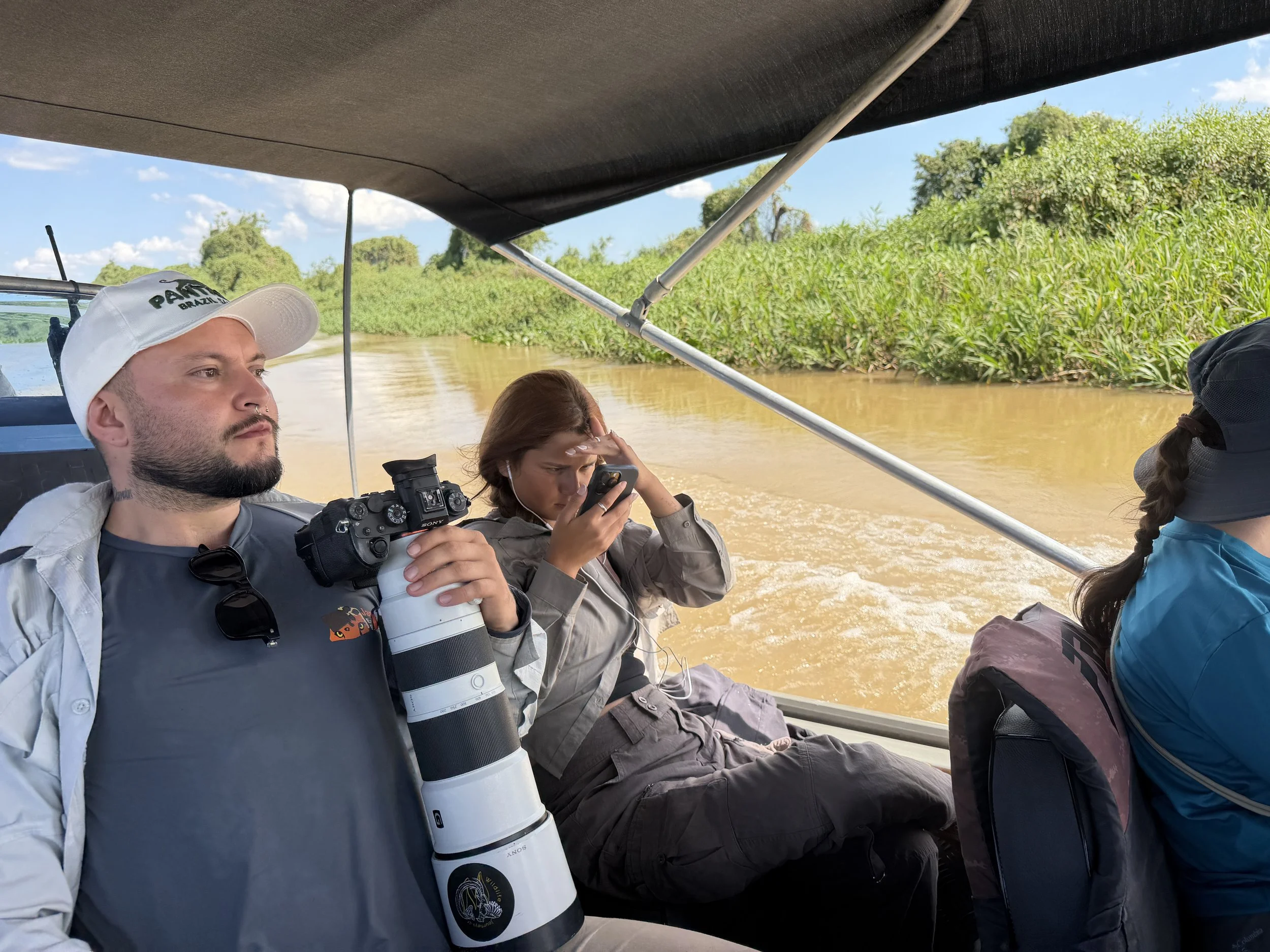
She had recently transferred to the University of Texas, and this was the day she was scheduled to meet with her advisor and discuss which classes she would receive.
It was a big deal.
She had tried to reschedule, but it was impossible, so reluctantly she joined the Zoom meeting from the boat to explain her situation.
She was terrified that they might be upset.
I told her to explain exactly where she was and what she was doing. Since wildlife photography is connected to her field of study, I felt that they would understand.
Her advisor was thrilled and wanted to know more about where she was.
Sophia showed her the river, the scenery, and the jaguars around us. What she feared might be an awkward situation turned into an incredible first meeting.
Even better, she got the classes she wanted.
I was extremely happy for her.
Later, we received word that a jaguar had just killed a caiman and was having trouble dragging it up the riverbank through the thick vegetation.
We raced over.
When we arrived, the dead caiman was still lying near the water, but the jaguar had disappeared.
After what must have been an exhausting struggle, the cat had gone uphill to rest.
The caiman was large, and it sounded like we had just missed an incredible hunt.
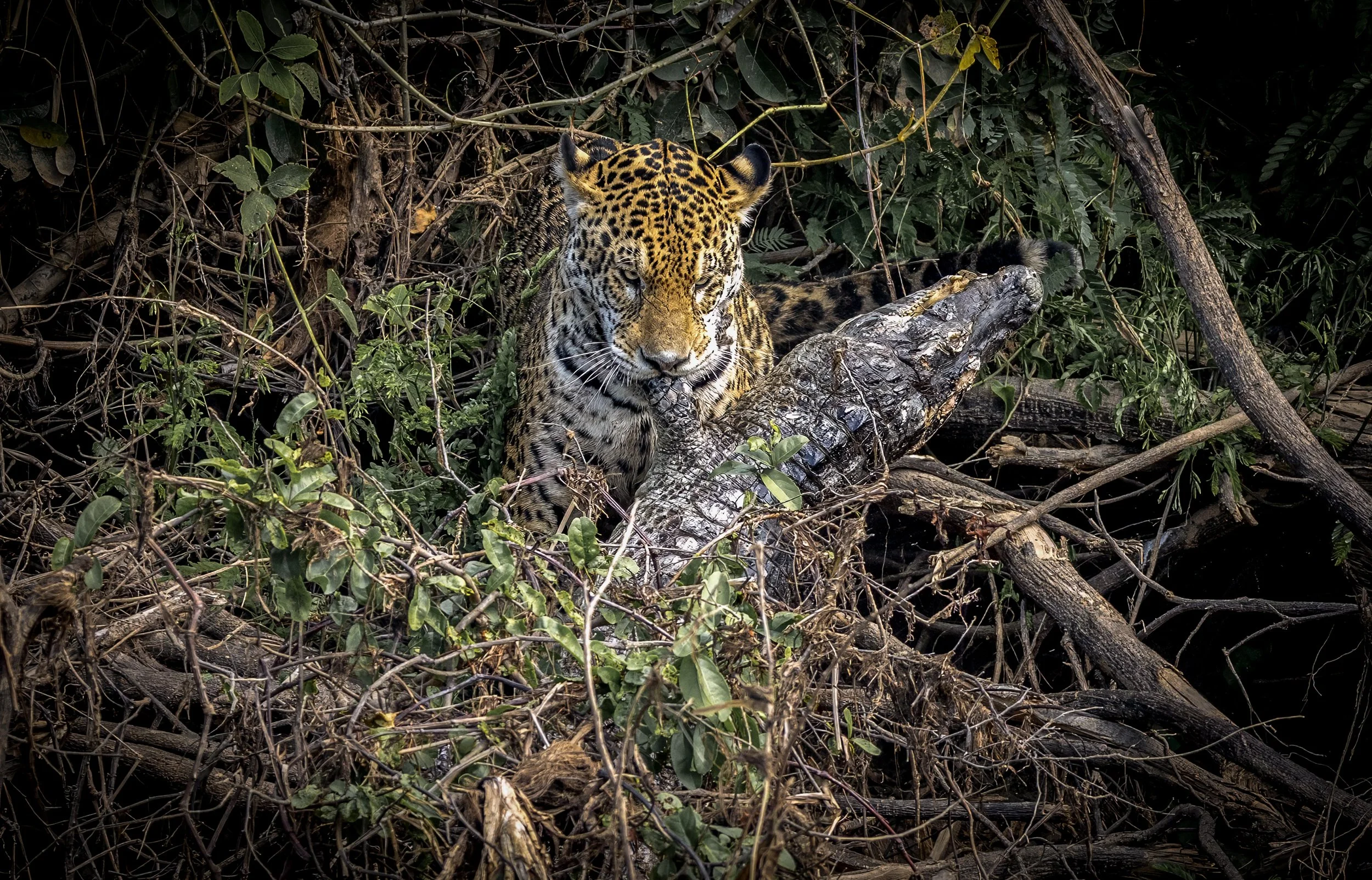
Rafa, a 3 year old male jaguar pulling his meal up the hill through very thick vegetation.
Eventually, the jaguar returned.
We watched as he grabbed the caiman and dragged it up the steep bank.
We were thrilled to photograph the aftermath, but still kicking ourselves for having missed the actual attack.
There was still time.
There were still plenty of jaguars out there.
The cat was Rafa, our third jaguar of the day.
He is a huge three-year-old male and the son of a jaguar named Courtney.
Our final cat appeared on a sandy bend in the river.
A large male was intensely smelling a tree.
A female in heat had recently marked it, and the male was clearly excited by the scent.
He added his own scent to the tree, then began walking slowly in the direction the female had traveled, following the trail she had left behind.
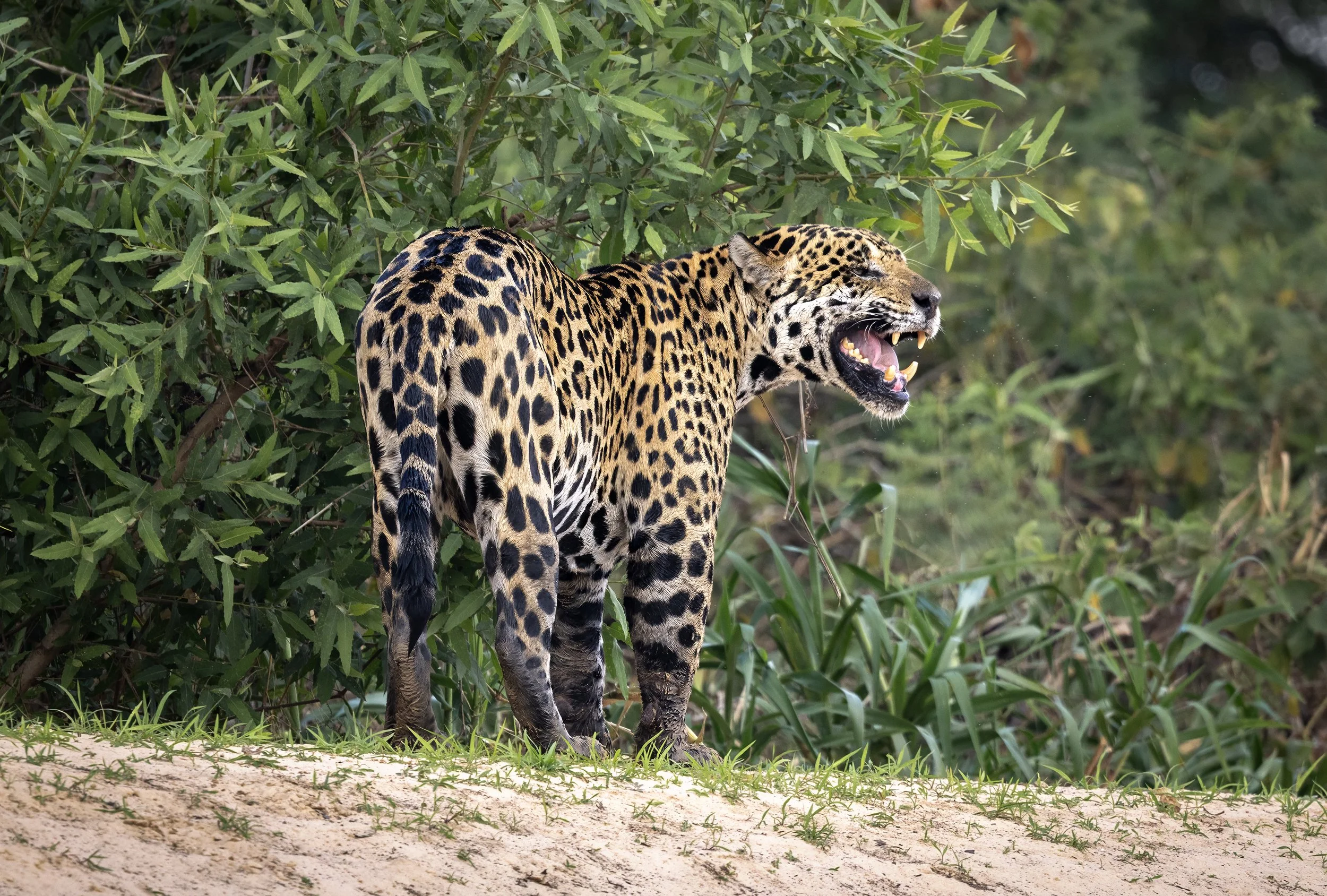
His name was Tomas.
He is four years old and became the fourteenth individual jaguar we identified during the trip.
With that final sighting, we decided it was time to call it a day.
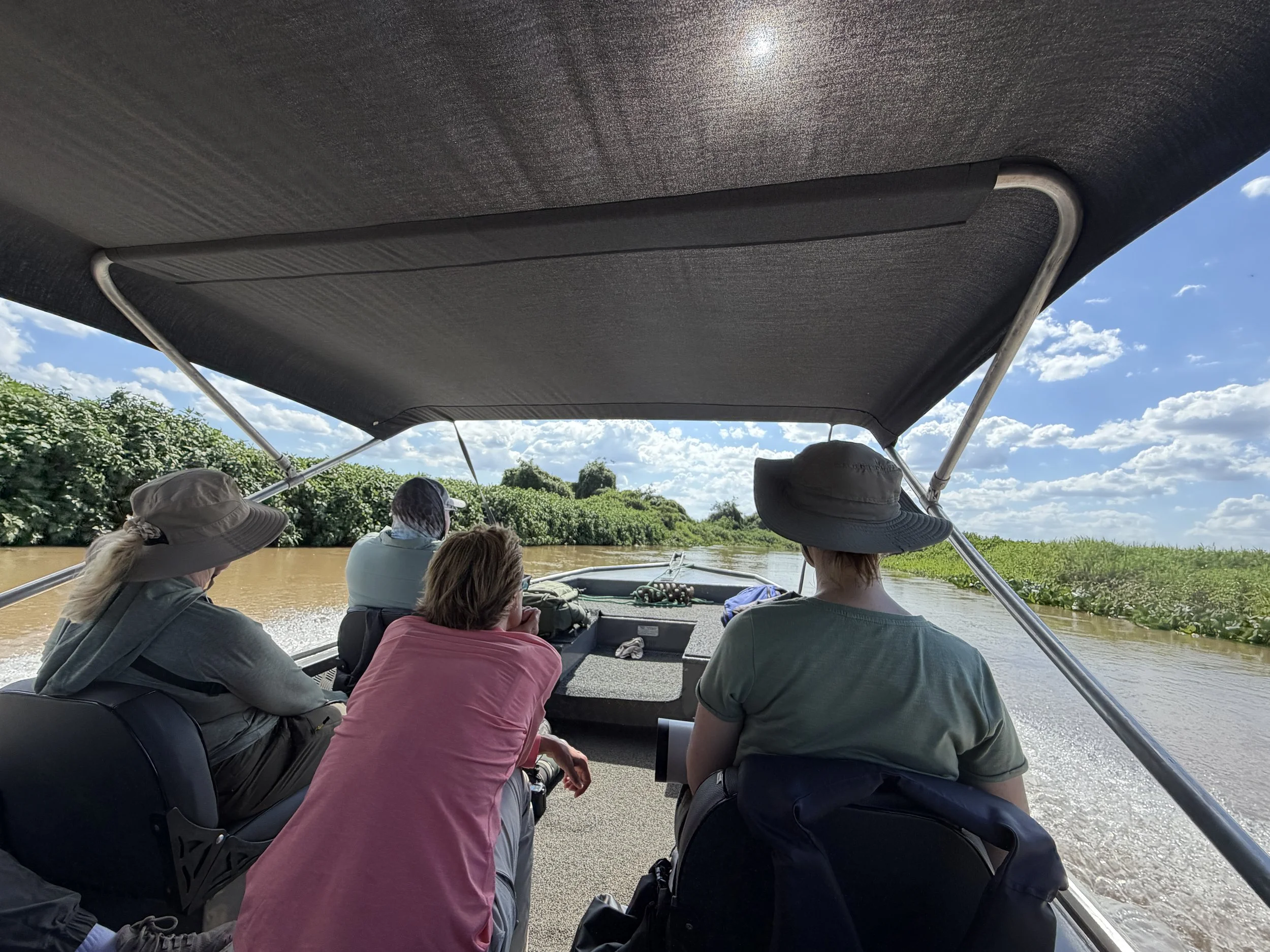
We returned to Porto Jofre to clean up, pack our gear, and prepare for the morning drive back to Cuiabá and the long journey home.
This trip exceeded every expectation we had.
Fourteen individually identified jaguars.
A maned wolf.
An ocelot.
Tapirs, giant river otters, anacondas, caimans, monkeys, birds, and more unforgettable moments than I can count.
What a trip.
What a place.
Until next season.
Love and will miss you Pantanal.
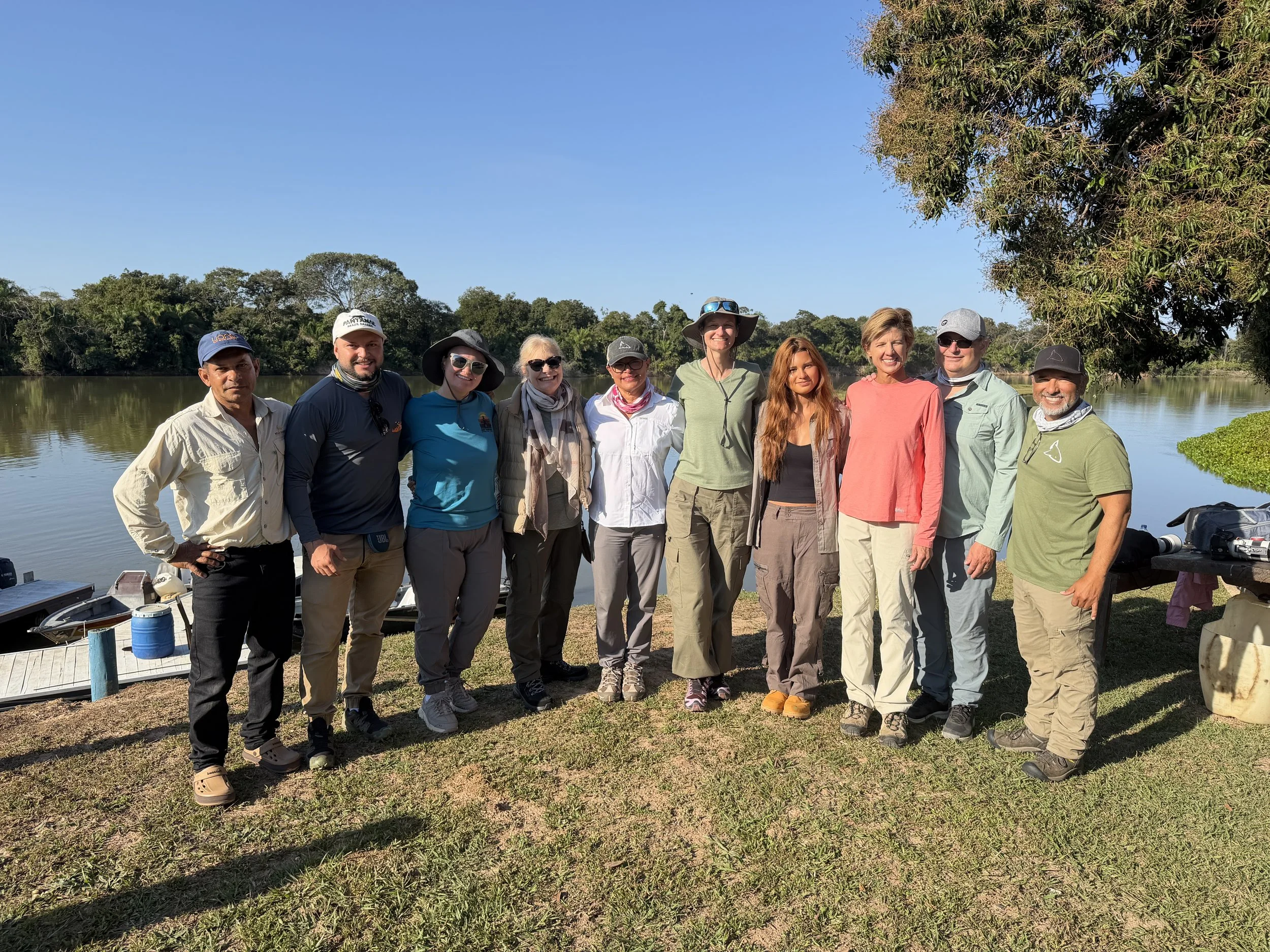
Experience the Pantanal Yourself
Every year the Pantanal tells a different story.
Different jaguars. Different behaviors. Different moments that no one could ever predict.
If you've enjoyed following this journey and would like to experience it firsthand, we'd love to have you join us on next year's expedition.
👉 Click here to learn more about our Northern Pantanal Jaguar Photography Expedition.