
Our new website...Hell Yea!

Well, I finally did it. I updated our website.

This has been one of those projects that has given me hell for years, costing thousands of dollars, endless frustration, and disappointment after disappointment.

For almost a decade, I pretty much gave up on the idea of building a new site.

I stuck with the original, flawed as it was, because at least it was ours.

Our first website. February 2002

Our first website. February 2002

But every time I looked at that old site, it bugged me.

I knew it could be better.

So after one last, desperate search for help, I decided… enough was enough. I was going to build it myself.

I built our original website for Shark Diver Magazine years ago, after being let down by the first round of web developers. And here’s the thing, most web developers I’ve worked with try to get too fancy. They get excited about the latest tech trend or some new design tool, and instead of giving me what I need, they end up overcomplicating it. And, well... it usually ends in a mess.
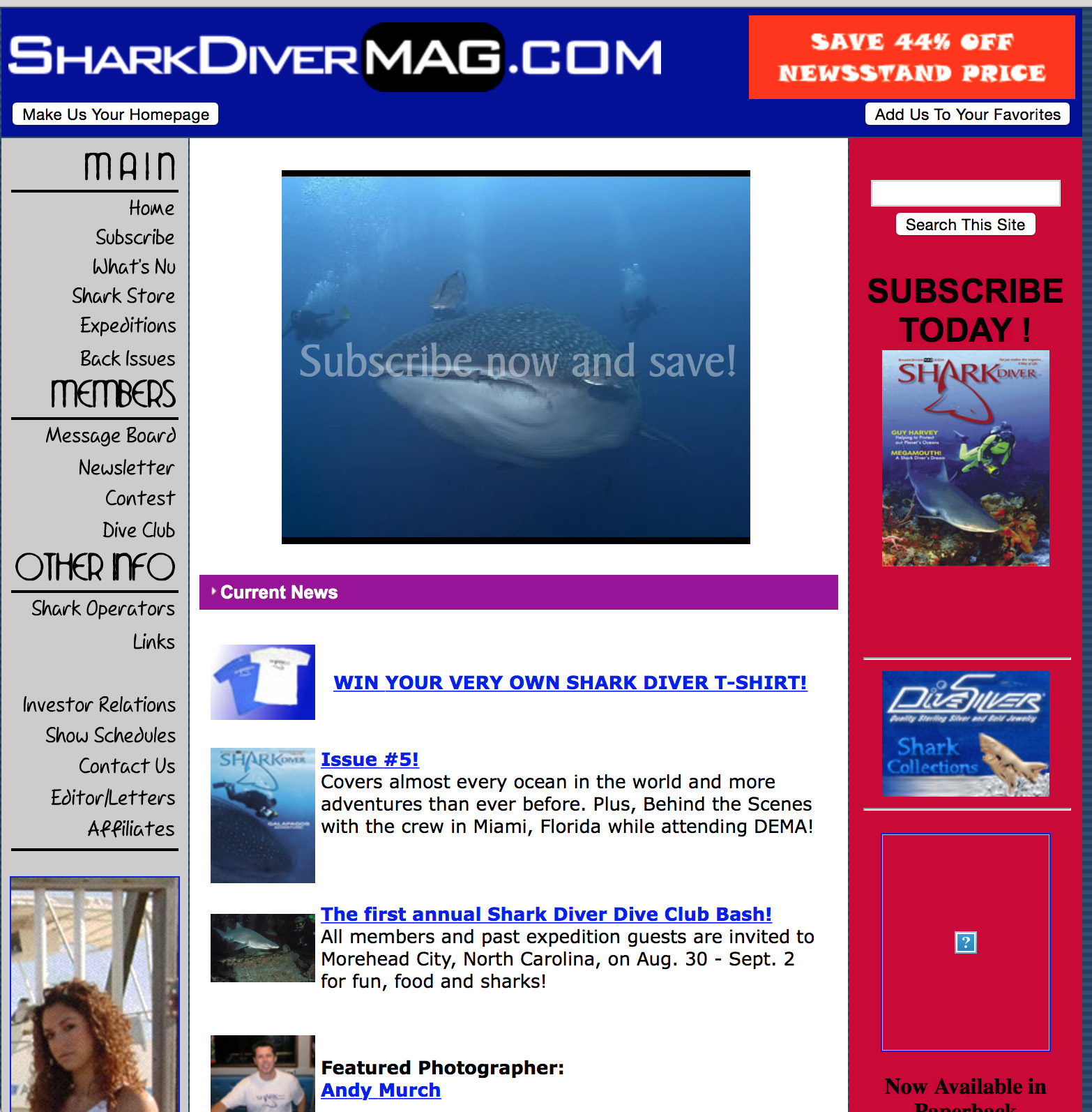
2nd attempt.

2nd attempt.

I wasn’t the most tech savy, still am not… but I was determined to get this thing done.

Thanks to a good friend (shoutout to Jero), I gave Squarespace a try. After a full day of fumbling through it, I picked a template I liked and just started building.

Slowly, it began to feel like something I could actually be proud of.

The first priority was getting back to the core of what SDM is all about, who we are and what we do: travel, adventure stories, and wildlife. From there, it was about creating a better experience for you, more content, more stories, and a gallery of images.

We’ve got thousands of photos sitting on hard drives, collecting dust.

So many moments worth sharing. Creating galleries was always something I dreamed of doing, and now it’s finally happening.

3rd facelift

3rd facelift

Next, I tackled the blog.

The old setup made blogging a total pain. I love writing, but it was just too clunky. Now, this new blog page is user-friendly, well, at least for me, and I plan to use it often.

So this is what you’re seeing now: the new look and feel of SDM Adventures.

We’re currently using sdmdiving.com as the main URL, mostly because I’m still figuring out how to connect sdmadventures.com. And there’s way too much history with sharkdivermag.com to let it go entirely. Eventually, I’ll migrate everything over, but for now, it’s baby steps. 

My first attempt as web designer.

My first attempt as a web designer.

I’ve been blogging on sharkdivermag.com since 2005.

I haven’t yet figured out how to bring all those old stories over here, but maybe I’ll find a way to link them.

There's a lot of history there, too much to lose. Again, baby steps.

And speaking of history…

Sadly, the old website is now down, and with it, all the years of blogging I’d been doing since 2005.

Losing all that history of stories hits hard.

I had documented our journey in real time, our early trips, our wins and struggles, the animals, the people, the behind-the-scenes stories. So many memories. So many moments now lost in cyberspace.

It’s something I’m not happy about. But I’m not giving up on them just yet.

I’ll check old backups, hard drives, even see if our former hosting provider has anything archived. Maybe, just maybe, I can link some of those old stories back into this new home. Baby steps. Always.

But if none of it comes back, then this blog becomes something even more important. A clean slate. A tribute to what came before. A place to keep telling the stories that still matter. Because there are so many left to share, and I’m not done yet.

Now, the store, that’s been the hardest part. For some reason, it’s always been a stumbling block. Every time I hired someone to help build a store, it turned into something bigger.

I’d ask for a simple store, they’d want to redesign the whole site, and I’d say yes (so yeah, this mess is kind of on me). Thousands of dollars later… no working store.

But not this time. I’m building it myself. And when it’s ready, I’ll proudly share it with you.

current site on SharkDiverMag.com

The final look of our website SharkDiverMag.com (2016), before we moved over to SDMdiving.com.

The store will include our shirts, rash guards, back issues of the magazine, and something I’ve always wanted: an art gallery of prints, featuring some of the most powerful moments we’ve captured over the years.

For now, I’m just excited to share the new site with you. It looks great, it feels right, and I hope you enjoy it and come back often. I’ll be updating it regularly, and the blog will feature both written and video stories. There’s still so much left to share, so many animals, places, and moments worth remembering.

To all our friends who’ve been with us from the beginning, this is for you.
Thank you for sticking with us through it all.

La Jolla Shores is Freaking Shark Diving Heaven!

1/320, f/5.6, ISO 125

La Jolla Shores has always held a special place for me. It was the site of my first beach dive, and, of course, it’s full of sharks.

The first time I swam here was in 2006. As the editor of Shark Diver Magazine, I had already published stories about La Jolla Shores and its thriving leopard shark population, so I was eager to experience it firsthand. I finally got my chance when we included the location in the documentary I produced, Summer of the Sharks.

1/320, f/5.6, ISO 125

Image by Keith Brooks

Image by Keith Brooks

For this dive/snorkel, you walk into the surf zone, and just a few feet beneath the waves, you’re surrounded by these beautiful little sharks. As a shark diver, it doesn’t get much better than that. My first dive here in 2006 was an unforgettable experience, and from that moment on, I was hooked. I made it a point to return every year since.

What makes La Jolla even more special is that leopard sharks aren’t the only stars of the show. The waters here are home to an impressive variety of shark species. You can encounter tope sharks, horn sharks, grey smooth-hounds, angel sharks, and the big stars of La Jolla—the seven-gill sharks.

I’ve been lucky enough to see them all, except for the elusive swell sharks. But no matter where you swim here, there’s always a shark nearby, lurking just beneath the surface, waiting to remind you why La Jolla is one of the best places in the world for shark encounters.

1/320, f/5.6, ISO 320

The leopards weren’t the only reason I came out here. I was also after tope sharks. Swimming among the grassy sea beds is where the topes tend to gather. These sharks are a true conservation success story. Once nearly wiped out, their numbers have rebounded thanks to the enforcement of the gill net ban along California’s coastline. Their return is not only great for the ecosystem, restoring balance to these waters, but it also adds to the excitement of an already incredible dive site.

I’ve been coming to this area since 2006, and while the sharks are always here and the diving is relatively easy, it’s not without its challenges. The ocean almost always has a strong surge, which wreaks havoc on visibility. Most of the time, I’m swimming in what feels like a muddy soup, trying to capture footage of these beautiful little sharks through the haze. Photography here is especially challenging. The constant movement of the water, shifting sand, and low visibility make it difficult to get sharp, well-lit images. Even with proper settings and adjustments, it’s a game of patience and luck.

1/320, f/5.6, ISO 250

This year, I finally got lucky. The stars aligned, and I had the rare opportunity to film them in near-perfect visibility. The surge was still there, and the sand was stirred up in places, but for once, I could see the sharks clearly, gliding effortlessly through the water. It was the kind of dive I had been waiting for.

We spent a lot of time playing with the leopards. Over two days, my friend, Margo Adamson, and my buddy Keith Brooks, and I logged about five hours in the water with them, and it was just pure fun.

1/320, f/5.6, ISO 320

Dive Tip. If you want the best chances of seeing them, I recommend diving during low tide. The vis is better during high tide, but they tend to scatter. During low tide, they gather in large groups, making for much better photography and filming opportunities.

1/320, f/5.6, ISO 160

The topes were a bit more challenging to film since they stay a bit deeper. On my second day, I went out later in the day, hoping for a chance to find them. Thanks to my friend Margo, who dives here practically every day, locating them wasn’t an issue.

They put me on them quickly, and I got to work trying to frame shots in fading light. Since I shoot with natural light, it was tough. The topes are much more skiddish compared to the leopards, so tracking them down, sneaking up to get a proper composition, and adjusting settings in low light made for an added challenge, but it was all part of the adventure.

Tope Shark. 1/320, f/5.6, ISO 320

Thankfully, the water here is super shallow, allowing plenty of natural light to filter through. With the great visibility we were lucky to have today, the photos turned out even better than I had imagined.

As I was heading back in, the SDG girls had one more surprise for me—a Pacific black sea turtle. This was a huge moment for me. I rushed over to photograph it, and like a supermodel, it stayed in place, patiently letting me take shot after shot.

1/320, f/5.6, ISO 3200

I’ve set a goal of photographing all eight species of sea turtles, and so far, I have four. This is actually a shared goal between my daughter, Sophie, and me. The plan is to film them together one day, and now that I know where to find a black turtle, I can bring her back here to experience them firsthand. The one we found is a resident in these waters, which makes it even more special.

1/320, f/5.6, ISO 3200


Photographing leopard sharks off La Jolla Shores was fun but challenging experience. The shallow water, ocean surge, and unpredictable lighting conditions pushed me to adapt on the fly. Looking back, there were a few things I could have done differently.

Here are five key lessons I took away from the experience…

1. Use a Faster Shutter Speed to Freeze Movement. I shot the leopard sharks using 1/320s shutter speed, which wasn’t quite fast enough to fully freeze their movement in the water. These sharks are constantly gliding, and between the motion of the surge and their natural speed, a faster shutter speed would have resulted in sharper, crisper images.

Lesson: A shutter speed of at least 1/500s–1/1000s is ideal for photographing moving sharks in natural light.

2. Avoid Auto ISO—Even in Changing Light. I’m usually against using Auto ISO, but in this case, I used it due to the rapidly changing light conditions. Some areas were only three to four feet deep, which meant a lot of light bouncing off the sandy bottom. This caused exposure shifts that I thought Auto ISO would help compensate for, but instead, it led to inconsistent noise levels across my shots.

Lesson: Manually Control ISO whenever possible, even in dynamic lighting. Instead of Auto ISO, set a base ISO and adjust in real-time as needed.

3. Work with the Surge, Not Against It. The constant water movement at La Jolla made it difficult to frame shots without the ocean pushing me around. At first, I tried to resist the surge, which only led to more camera shake and missed shots. I eventually learned to go with the flow—literally. By drifting with the water, I was able to anticipate movement and time my shots more effectively.

Lesson: Let the surge guide you into position rather than fighting it. Time your shots during the brief moments when the water steadies.

4. Use a Lower Angle for More Impactful Compositions. Most first-time shark photographers make the mistake of shooting downward, which flattens the subject and makes the image less dynamic. I made sure to position my camera lower in the water and shoot upward whenever possible. This approach separated the sharks from the busy background, improved contrast, and created a more engaging composition.

Lesson: Get low and shoot upward for a more dramatic and visually appealing shot.

5. Patience Beats Pursuit Every Time. Leopard sharks are curious but easily spooked. The more I moved toward them, the more they swam away. When I finally stayed still and let them come to me, they got comfortable and allowed for much closer shots. This not only resulted in better images but also let me observe their natural behavior without disturbing them.

Lesson: Let the wildlife come to you. Staying still increases your chances of getting close, natural shots without chasing the subject away.

Photographing leopard sharks at La Jolla Shores was a learning experience.

It reinforced the importance of controlling shutter speed, managing ISO manually, adapting to ocean movement, and being patient with wildlife. Every dive teaches a new lesson, and next time, I’ll be better prepared to capture these beautiful sharks with even sharper, more dynamic images.


Until the next one and thank you guys for reading.

*New Blogs posted 3–4 times a week.
(sometimes more.)
Follow along for fresh stories, trip updates, and raw moments from the wild.